Origin and characterization of super-Earths and sub-Neptunes

Origin and characterization of super-Earths and sub-Neptunes
Léna Parc, Julia Venturini, François Bouchy, Ravit Helled, Caroline Dorn, Adrien Leleu, Yann Alibert, Simon Müller, Haiyang Wang
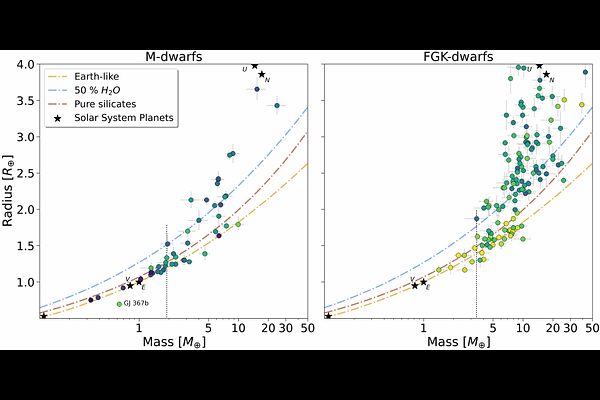
AbstractSuper-Earths and sub-Neptunes represent the most common class of exoplanets discovered to date in our galaxy, yet they have no direct analogues in the Solar System. Since 2014, researchers within the NCCR PlanetS have made significant contributions to understanding the origin and nature of these small planets. This chapter provides an overview of the progress made in their detection, characterization, and theoretical interpretation during the 2014-2025 period. The combined data from space-based photometric missions such as Kepler and TESS, together with ground-based radial velocity campaigns using state-of-the-art spectrographs (e.g., HARPS, ESPRESSO, NIRPS), have enabled detailed demographic analyses of these planets. These observational efforts are complemented by theoretical work exploring their internal structures, bulk compositions, formation and evolution, shedding light on the physical processes responsible for the observed diversity. As high-precision observations from facilities like JWST begin to probe the atmospheric composition of individual planets, a more complete picture of super-Earth and sub-Neptune origins is emerging, one that continues to challenge and refine current planet formation theories.