Seasonal Variability of Pluto's Haze Formation Revealed by Laboratory Simulations

Seasonal Variability of Pluto's Haze Formation Revealed by Laboratory Simulations
Zhengbo Yang, Chao He, Yu Liu, Sai Wang, Haixin Li, Yingjian Wang, Xiao'ou Luo, Sarah M. Horst, Sarah E. Moran, Veronique Vuitton, Laurene Flandinet, Patricia McGuiggan
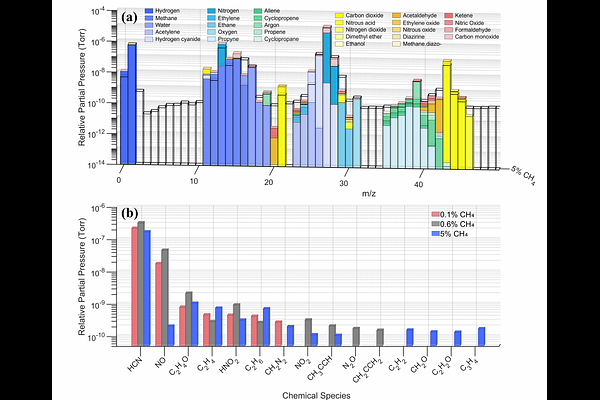
AbstractPluto possesses a thin atmosphere primarily composed of N2, with minor constituents including CO and CH4. Photochemical processes generate distinct haze layers as observed by the New Horizons spacecraft. However, the mechanisms governing haze formation, as well as the composition and physical properties of the hazes, remain poorly constrained. Due to Pluto's highly eccentric orbit and obliquity, its surface temperature and atmospheric composition undergo substantial seasonal variations, but it is unclear how such seasonal variations impact the chemical pathways and efficiency of haze formation in Pluto's atmosphere. To address this, we conducted a laboratory simulation of Pluto's atmospheric photochemistry, in which N2/CH4/CO gas mixtures with CH4 concentrations varying from 0.1% to 5% were exposed to a glow discharge to initiate photochemical reactions. Gas-phase composition was monitored in situ using a residual gas analyzer (RGA), while the solid-phase products were characterized by atomic force microscopy (AFM), a gas pycnometer, infrared spectroscopy (IR), and very high-resolution mass spectrometry (VHRMS) to determine particle sizes, density, and composition, respectively. Our results show that increasing the CH4 mixing ratio significantly enhances the yield of gas and solid products. Under low CH4 conditions, nitrogen is primarily incorporated into solids as cyanide groups; whereas CH4-rich conditions favor the formation of amino groups, greatly promoting nitrogen incorporation into organic solids. These findings not only shed light on how seasonal variations into Pluto's atmosphere composition influence haze formation pathways, but also provide critical parameters to interpret observational data and to improve photochemical and microphysical models of planetary hazes.