A Turbulence-Driven Magnetic Reconnection Model for the High-Energy Neutrino Emission from NGC 1068

A Turbulence-Driven Magnetic Reconnection Model for the High-Energy Neutrino Emission from NGC 1068
Luana Passos-Reis, Elisabete M. de Gouveia Dal Pino, Juan C. Rodríguez-Ramírez, Giovani H. Vicentin
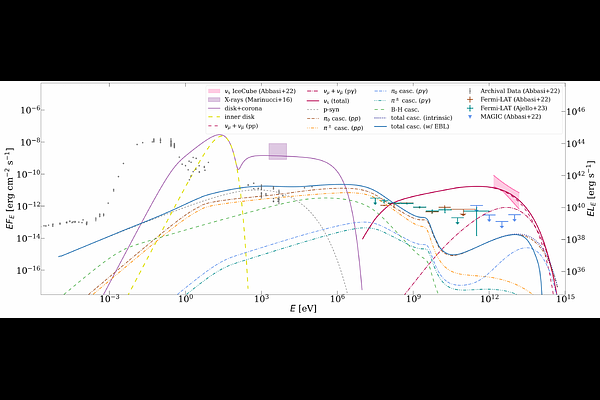
AbstractWe model the Seyfert II AGN NGC 1068 within a turbulence-induced magnetic reconnection framework to explain its high-energy emission. Observations reveal a neutrino flux excess higher than the observed GeV gamma-ray emission by orders of magnitude, with no detected TeV counterpart, suggesting efficient hadronic acceleration in the nuclear region with strong gamma-ray absorption. Assuming that proton acceleration occurs in a turbulent reconnection layer via a first-order Fermi process, we use a lepto-hadronic model based on a coronal-accretion disk configuration in which magnetic field lines anchored to the $2 \times 10^{7} M_{\odot}$ black hole horizon reconnect with field lines from the inner accretion disk corona. Our model matches the observed spectral energy distribution with a magnetic field $B_{c} \sim 10^{4}$ G and magnetic reconnection power $\dot{W_{B}} \sim 10^{43}$ erg s$^{-1}$, with $\sim 50\%$ efficiency in proton acceleration. Unlike previous studies, we find that both particle acceleration and emission take place in the inner region, where protons reach $\sim 10^{14}$ eV via first-order Fermi acceleration within the turbulent reconnection layer, rather than drift acceleration. These protons interact with disk photons, coronal X-rays, and coronal protons, producing neutrinos, predominantly via $pp$ interactions, at levels consistent with IceCube detections. The associated gamma-rays are attenuated by $γγ$ annihilation, remaining below current upper limits. Turbulence-driven reconnection is thus a viable mechanism for neutrino production in the coronal region of NGC 1068 and similar sources.