STAR-Magic Mutation: Even More Efficient Analog Rotation Gates for Early Fault-Tolerant Quantum Computer

STAR-Magic Mutation: Even More Efficient Analog Rotation Gates for Early Fault-Tolerant Quantum Computer
Riki Toshio, Shota Kanasugi, Jun Fujisaki, Hirotaka Oshima, Shintaro Sato, Keisuke Fujii
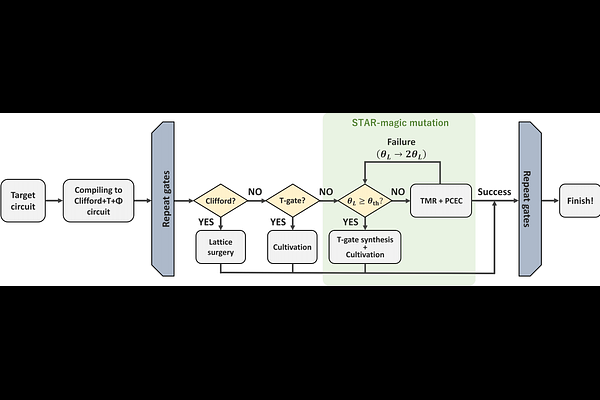
AbstractWe introduce STAR-magic mutation, an efficient protocol for implementing logical rotation gates on early fault-tolerant quantum computers. This protocol judiciously combines two of the latest state preparation protocols: transversal multi-rotation protocol and magic state cultivation. It achieves a logical rotation gate with a favorable error scaling of $\mathcal{O}(θ_L^{2(1-Θ(1/d))}p_{\text{ph}})$, while requiring only the ancillary space of a single surface code patch. Here, $θ_L$ is the logical rotation angle, $p_{\text{ph}}$ is the physical error rate, and $d$ is the code distance. This scaling marks a significant improvement over the previous state-of-the-art, $\mathcal{O}(θ_L p_{\text{ph}})$, making our protocol particularly powerful for implementing a sequence of small-angle rotation gates, like Trotter-based circuits. Notably, for $θ_L \lesssim 10^{-5}$, our protocol achieves a two-order-of-magnitude reduction in both the execution time and the error rate of analog rotation gates compared to the standard $T$-gate synthesis using cultivated magic states. Building upon this protocol, we also propose a novel quantum computing architecture designed for early fault-tolerant quantum computers, dubbed ``STAR ver.~3". It employs a refined circuit compilation strategy based on Clifford+$T$+$φ$ gate set, rather than the conventional Clifford+$T$ or Clifford+$φ$ gate sets. We establish a theoretical bound on the feasible circuit size on this architecture and illustrate its capabilities by analyzing the spacetime costs for simulating the dynamics of quantum many-body systems. Specifically, we demonstrate that our architecture can simulate biologically-relevant molecules or lattice models at scales beyond the reach of exact classical simulation, with only a few hundred thousand physical qubits, even assuming a realistic error rate of $p_{\text{ph}}=10^{-3}$.