Shock-induced magnetic reconnection driving Ellerman bomb emission and a spicule

Shock-induced magnetic reconnection driving Ellerman bomb emission and a spicule
Mats Ola Sand, Quentin Noraz, Guillaume Aulanier, Juan Martínez-Sykora, Mats Carlsson, Luc Rouppe van der Voort
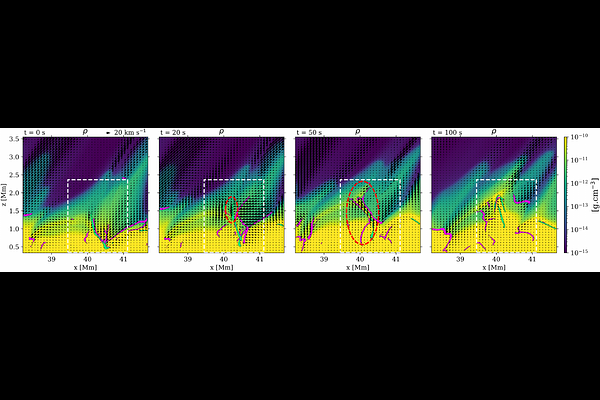
AbstractThe mechanism that forms dynamic type II spicules has remained elusive for many years. Their dynamical behaviour has long been linked to magnetic reconnection, yet no conclusive evidence has been provided. However, one recent observational study found signs of reconnection, as traced by Ellerman bombs (EBs), at the footpoints of many spicules. The triggering of EBs is generally linked to reconnection due to flux emergence and convective motions in the photosphere. We aim to explore whether we can connect EBs to type II spicules, and to what extent we can use EBs as an observational proxy to probe reconnection in this dynamic. We also aim to provide further insight into the mechanisms that trigger EBs. We used a simulation run with the radiative magnetohydrodynamics code Bifrost to track spicules and study the physical processes behind their formation. To detect EBs and classify the spicules, we synthesised the H-alpha line using the multilevel radiative transfer code RH1.5D. We also traced shocks and current sheets to decipher the origin of EBs and spicules. We selected one type II spicule with a strong EB near its footpoint and studied their formation in detail. A magnetoacoustic shock advects the magnetic field lines towards an oppositely directed ambient field, creating a current sheet. The current sheet accelerates dense plasma via a whiplash effect generated by reconnection into the inclined ambient field, launching the spicule. Several EB profiles trace shock- and magnetic-reconnection-induced dynamics during this process at the spicule footpoint. We present a new EB triggering mechanism in which a shock-induced current sheet reconnects, triggering an EB in the lower solar atmosphere. The shock-induced current sheet generates the launch of a type II spicule via reconnection outflows. These results provide a physical origin for the observed connection between EBs and spicules.