Design, Testing, and Commissioning of the Sun Yat-sen University (SYSU) 80 cm Infrared Telescope

Design, Testing, and Commissioning of the Sun Yat-sen University (SYSU) 80 cm Infrared Telescope
Zhong-Nan Dong, Bin Ma, Chun Chen, Wei-Sen Huang, Jin-Ji Li, Jia-Qi Lin, Yun Shi, Hao-Ran Zhang, Duo-Le Cao, Bao-Gang Chen, Tai-Ran Deng, Rui-Chen Gao, Yi Hu, Hong-Zhuang Li, Xia Li, Pu Lin, Yang Liu, Bo Ma, Rong-Feng Shen, Li-Duo Song, Fang-Yu Xu, Hao-Nan Yang, Yan Yu, Jun Yuan, Xiang-Tao Zeng, Hao-Yuan Zheng
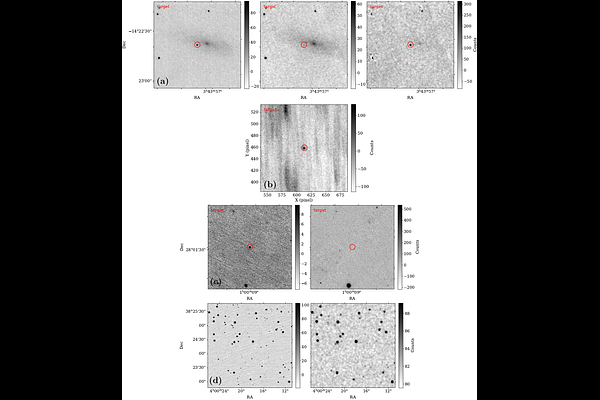
AbstractThe Sun Yat-sen University (SYSU) 80 cm telescope is a new generation near-infrared (NIR) facility in China dedicated to time-domain astronomy, while also serving as a testbed for emerging NIR cameras. Commissioned in October 2024 at the 4100 m Lenghu site on the Tibetan Plateau in China, the telescope adopts a reflective Cassegrain design with two Nasmyth foci for J and K bands. The J band imaging system, initially equipped with a 640 x 512 off-the-shelf InGaAs camera (INS Mars640) and upgraded in June 2025 to a 1280 x 1024 science-grade, deeply cooled camera (YNAOIR), achieves background-limited performance with a dark current of ~ 14 e-/s/pix and a readout noise of ~ 11 e-. The system reaches a limiting magnitude of J ~ 17 mag (Vega system) in single 20 s exposures and depths of J ~ 19.4 mag with stacked 30 minute exposures. For a variable with J ~ 14 mag during on-sky tests, the system delivers millimagnitude-level photometric precision. Since commissioning, the telescope observed transients such as gamma-ray bursts (GRBs), supernovae and comets, variables including active galactic nuclei (AGNs), high-redshift quasars (z > 6), and brown dwarfs, as well as deep-field imaging reaching J ~ 20.5 mag. This validates the feasibility of using InGaAs cameras for astronomical observations, encouraging other institutions to develop dedicated infrared telescopes or integrate infrared cameras into existing optical telescopes.