Simulating the LOcal Web (SLOW): VII. Intergalactic magnetic field models for multi-messenger applications

Simulating the LOcal Web (SLOW): VII. Intergalactic magnetic field models for multi-messenger applications
Johannes Stoiber, Klaus Dolag, Francesca Capel, Benjamin Seidel, Michael Kachelrieß, Ludwig M. Böss, Jenny G. Sorce
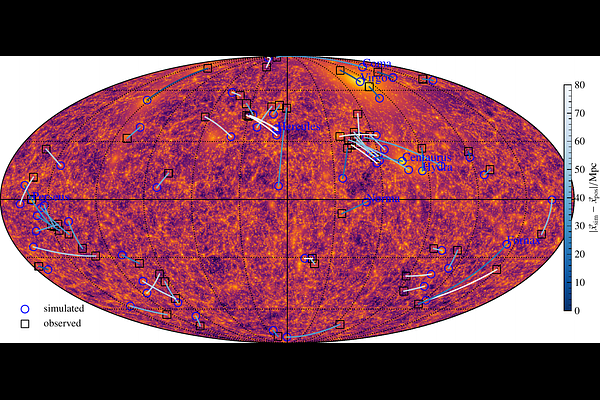
AbstractContext. The propagation of ultra-high-energy cosmic rays (UHECRs) and ultra-high-energy gamma-rays remains an open question in astroparticle physics, with the intergalactic magnetic field (IGMF) playing a crucial role in deflecting charged particles and shaping electromagnetic cascade spectra. Characterizing the IGMF across cosmic large-scale structure is therefore essential for interpreting multi-messenger observations and constraining the magnetogenesis scenarios that seeded it. Aims. We aim to provide accurate IGMF models to the astroparticle physics community and test their properties and robustness. Methods. We analyze IGMF models derived from the constrained cosmological simulation SLOW alongside a set of rescaled magnetic field models. We further introduce a novel algorithm to determine an "ideal position" for galaxies lying below the constraining power of the initial conditions, enabling accurate line-of-sight magnetic field extraction toward relevant sources. Results. The models span a wide range of filling factors and sample distinct regions of the electron density-magnetic field strength phase space in filaments, while converging in the cores of galaxy clusters; the simulated field from SLOW best reproduces the IGMF derived from the electromagnetic gamma-ray cascade. Models extracted using the introduced "ideal position" yield improved accuracy and may benefit multi-messenger studies more broadly. The large-scale structure drift of simulated clusters exploited by the algorithm also offers a potential route to refining the simulation's constrained initial conditions.