Automated experimental design for high-probability entanglement generation

Automated experimental design for high-probability entanglement generation
Carlos Ruiz-Gonzalez, Mario Krenn, Xuemei Gu
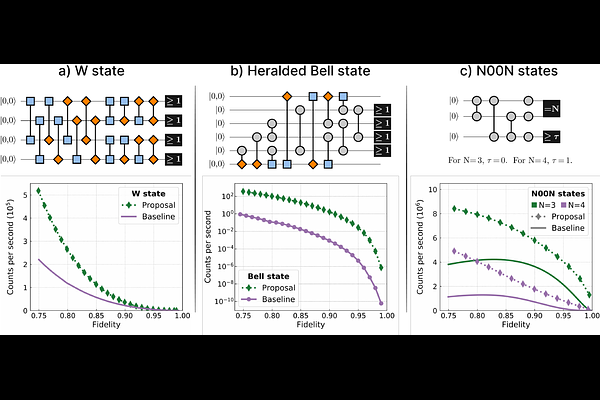
AbstractEntangled photons are widely used in quantum technologies. Many photonic experiments generate them with probabilistic photon-pair sources that can be modeled as squeeze operators. In practice, these sources are usually treated in the low-gain (perturbative) regime, keeping only the leading single-pair term and neglecting higher-order multi-pair emission events. In pursuit of fidelity, the probability of successful entanglement generation can become extremely small, a tradeoff often ignored. Here we develop an automated design algorithm for quantum experiments to optimize both fidelity and success probability while accounting for higher-order multi-pair emissions. Our discovery algorithm explores different design topologies subject to varying hardware constraints. It optimizes the source parameters to reduce undesired higher-order terms or even benefit from them. The experiments presented outperform previous proposals for widely used states, including heralded Bell states, W states, and NOON states, paving the way for more efficient photonic technologies.