Infrared Corrections and Horizon Phase Transitions in Kaniadakis-Based Holographic Dark Energy

Infrared Corrections and Horizon Phase Transitions in Kaniadakis-Based Holographic Dark Energy
Manuel Gonzalez-Espinoza, Samuel Lepe, Joel F. Saavedra, Francisco Tello-Ortiz
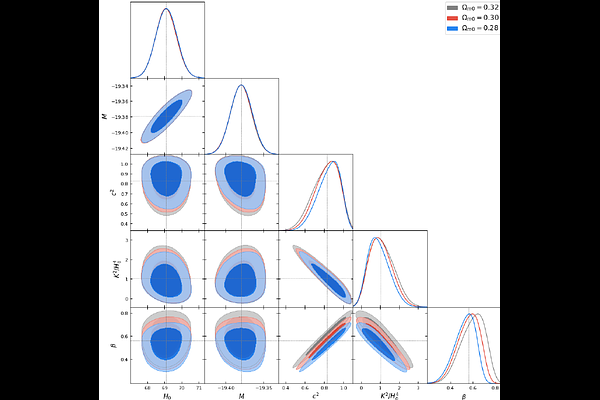
AbstractWe study the cosmological and thermodynamic implications of holographic dark energy derived from the Kaniadakis deformation of the Bekenstein-Hawking entropy. Within a spatially flat FLRW background, the generalized entropy leads to an effective dark energy density containing an infrared correction proportional to $H^{-2}$, modifying the dynamics of the apparent horizon. Using the Hayward Kodama formalism, we obtain a geometric equation of state and perform a criticality analysis, revealing a Van der Waals type structure with an inverted first order phase transition and a non physical swallowtail behavior in the Gibbs free energy, indicative of unstable thermodynamic branches. We further examine a dynamical extension including a $\dot{H}$ contribution and show that the unconventional critical behavior persists. The phenomenological viability of the model is tested through a joint statistical analysis with cosmic chronometers, PantheonPlus Type Ia supernovae, and DESI baryon acoustic oscillation data. These results establish Kaniadakis holographic cosmology as a consistent framework linking generalized entropy, gravitational thermodynamics, and observationally viable dark energy dynamics.