MOSAIC at ELT: Design and First Performance Results of Novel Robotic Optical-Relay Positioners

MOSAIC at ELT: Design and First Performance Results of Novel Robotic Optical-Relay Positioners
Maxime Rombach, Markus Thurneysen, Lucas Ortolani, Jurgen Schmoll, Diane Chapuis, Malak Galal, Sebastien Pernecker, Cassio Berni, Ojonugwa Adukwu, Fabio Fialho, Michaela Hirschmann, Jean-Paul Kneib
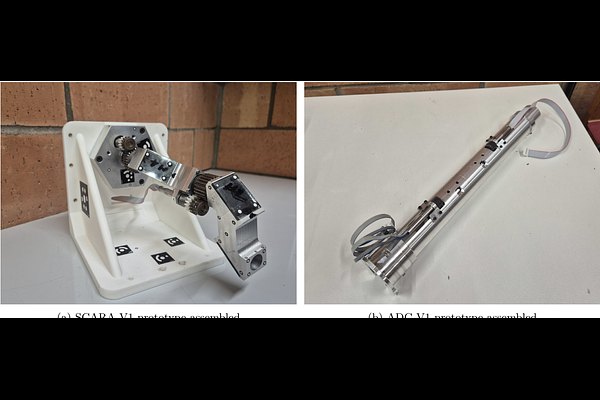
AbstractThe Extremely Large Telescope (ELT) is, to date, the most ambitious ground-based telescope under construction. MOSAIC is a multi-objects spectrograph (MOS) that aims to make full use of the largest telescope in the world. At its heart, about 300 robotic positioners will pick-off skylight from the focal surface of the ELT to feed it to its Near Infrared (NIR) and visible (VIS) spectrographs. The gigantic scale of the ELT presents three main challenges for MOSAIC positioners: (1) the light beams on the focal surface cannot be focused in a single fiber, similarly to other MOS instruments, involving a design with relay mirrors patrolling the field of view, and reimaging the sub-field on 2 fixed fiber bundles located 600 mm behind the ELT focal plane (2) The positioner needs to adapt to the local telecentricity, which means it has to point at the ELT pupil center located 37.868 m away from the focal plane (3) The Atmospheric Dispersion Corrector (ADC) needed to cover the whole focal surface of the ELT is impossible to build to this scale; hence each positioner needs its own ADC. EPFL is responsible for designing and supervising the mass manufacturing of the positioners. This paper aims to present its initial design and prototypes.