The broadband spectral energy distribution of candidate neutrino blazars

The broadband spectral energy distribution of candidate neutrino blazars
Athira M Bharathan, C. S. Stalin, Markus Böttcher, S. Sahayanathan, Blesson Mathew, Subir Bhattacharyya
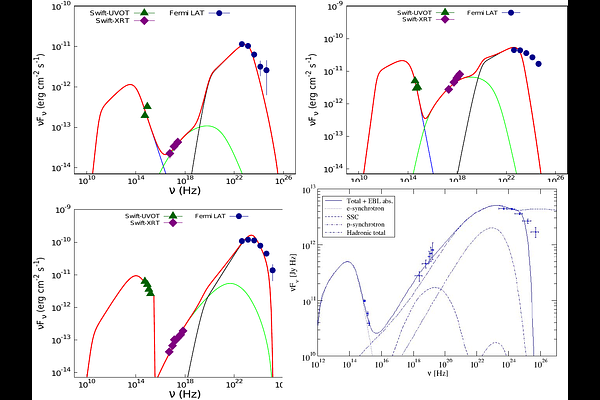
AbstractBlazars, the jet dominated class of AGN comprising flat spectrum radio quasars (FSRQs) and BL Lac objects (BL Lacs) are now increasingly identified as potential sources of high energy neutrinos. Such neutrino blazars are ideal targets to investigate the high energy emission processes and to understand their role as neutrino sources. We report results on four candidate neutrino blazars, PKS 0446+112, TXS 0506+056, PKS 1424$-$418 and PKS 1502+106. We carried out $γ$-ray spectral and timing analysis on three time periods that comprise a quiescent epoch, an epoch that corresponds to neutrino detection and a flaring epoch. We also carried out modeling of the broadband pectral energy distribution (SED) on those three epochs. We found that the $γ$-ray spectra of the BL Lac TXS 0506+056 can be adequately described by a power-law, while the spectra of the other three FSRQs require a log-parabola model. On shorter timescales, we observed flux variability with doubling/halving timescales of 4.70 hrs, 9.24 hrs, 30.76 hrs and 15.42 hrs for PKS 0446+112, TXS 0506+056, PKS 1424$-$418 and PKS 1502+106, respectively. The SEDs of most of the epochs for the sources are well explained by a leptonic scenario. However, the quiescent epoch of PKS 1502+106 and the neutrino-emission epoch of PKS 0446+112 required an additional hadronic component to reproduce the observed SEDs. Our analysis reveals a complex interplay of leptonic and hadronic processes. While certain neutrino-associated epochs align with a leptonic model, others necessitate a hadronic component to explain the emission features.