How Massive Can a Population III Starburst Be? Simulating the First Galaxies with High Lyman-Werner Background

How Massive Can a Population III Starburst Be? Simulating the First Galaxies with High Lyman-Werner Background
Tae Bong Jeong, Alessandra Venditti, Volker Bromm, Myoungwon Jeon, Tiger Yu-Yang Hsiao, Steven L. Finkelstein, John Chisholm
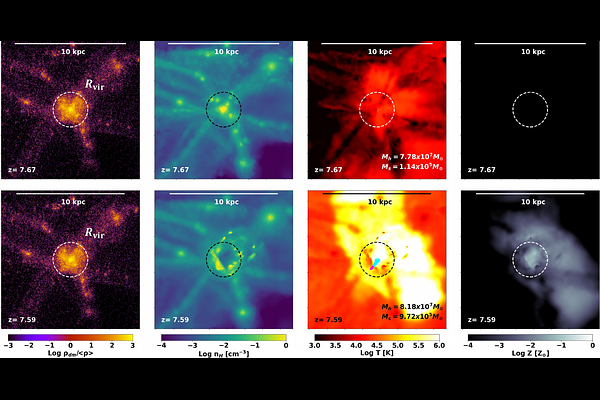
AbstractObserving the first generation of Population~III (Pop~III) stars is one of the most demanding challenges in astronomy. Indeed, Pop~III stars are expected to predominantly form within faint minihalos at early times with a top-heavy initial mass function, resulting in efficient metal enrichment and a fast transition to Pop II-dominated systems. However, recent surveys with the James Webb Space Telescope (JWST) have identified galaxies at the end of the Epoch of Reionization (EoR) with possible signatures of significant Pop~III star formation even at these later times. We here explore the physical conditions required to produce massive Pop~III starbursts during the EoR, using cosmological radiation-hydrodynamic zoom-in simulations. We specifically focus on galaxies with a virial (dynamical) mass of $M_{\rm vir} \approx 10^{8} \msun $ at $7 \lesssim z \lesssim 8$, i.e., the atomic-cooling halos that could be potential sites for such maximal Pop~III starbursts. In particular, we vary the strength of Lyman-Werner (LW) background radiation up to $J_{\rm LW} \leq 10^4J_{21}$, further imposing a high star formation efficiency (up to $ε_{\rm ff} = 1.0$). Our results show that Pop~III starbursts, observable in strongly-lensed survey fields like GLIMPSE, can occur in the presence of a sufficiently high LW flux (with $\gtrsim 10^3J_{21}$), leading to delayed, but intense Pop~III star formation. However, even for such high LW fluxes, the Pop~III starburst mass is limited to $M_{\star, \rm Pop~III} <10^6\msun$, as strong internal metal enrichment occurs after the first Pop~III supernova explosions within the simulated galaxies. While the conditions favoring observable Pop~III starbursts are expected to be rare, we anticipate that future and ongoing large-volume surveys leveraging gravitational lensing, such as VENUS, will detect multiple cases of Pop~III starbursts in the EoR.