Computing noise-canceling observables via Pauli propagation

Computing noise-canceling observables via Pauli propagation
Andrew Eddins, Caleb Johnson, Alberto Baiardi, Francesco Tacchino, Ewout van den Berg, Roy Elkabetz, Vinay Tripathi, Swarnadeep Majumder, Max Rossmannek, Liran Shirizly, Abhinav Kandala
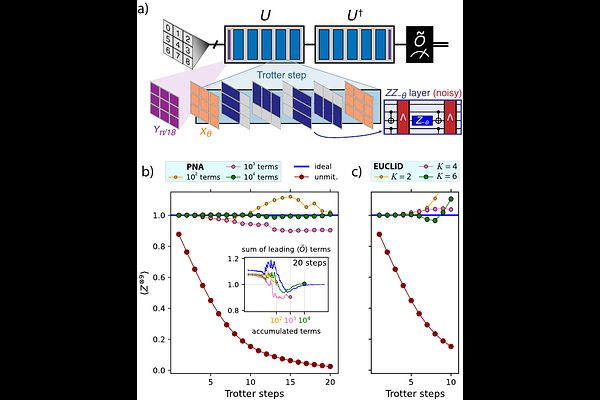
AbstractThe pursuit of quantum advantage is driving the co-evolution of quantum processors and classical simulation methods. Despite advances in scale and quality, the accuracy of quantum simulation is ultimately limited by error rates and sampling overheads. Similarly, while classical simulation methods such as Pauli propagation have made remarkable progress, their accuracy is ultimately limited by the exponential growth of operator paths and the truncations needed to control memory and runtime. Here we show that these complementary limitations can be mitigated by embedding Pauli propagation within a hybrid error-mitigation framework that reduces quantum sampling overhead while achieving lower truncation errors with fewer classical resources than traditional Pauli propagation alone. In this framework, a target observable is classically propagated through noise-canceling inverse channels, producing a modified observable that is measured directly on a quantum processor. We prototype two implementations and benchmark their performance numerically on canonical models that challenge traditional Pauli propagation. We also perform experiments on a quantum processor using 56 superconducting qubits, revealing the tradeoffs of their respective truncation strategies. These results illustrate how classical and quantum resources can be orchestrated to extend observable estimation beyond the limits of either approach alone, providing a foundation for quantum-centric supercomputing and future demonstrations of quantum advantage.