The ALMA REBELS Survey: The [C II] Luminosity Function of UV-Selected Galaxies at $z\sim7$

The ALMA REBELS Survey: The [C II] Luminosity Function of UV-Selected Galaxies at $z\sim7$
Thomas Herard-Demanche, Pascal A. Oesch, Rychard Bouwens, Jacqueline A. Hodge, Hiddo S. B. Algera, Manuel Aravena, Karin Cescon, Elisabete da Cunha, Pratika Dayal, Andrea Ferrara, Rebecca Fisher, Yoshinobu Fudamoto, Kasper E. Heintz, Hanae Inami, Andrea Pallottini, Lucie E. Rowland, Renske Smit, Laura Sommovigo, Mauro Stefanon, Michael W. Topping, Paul van der Werf, Ivana F. van Leeuwen
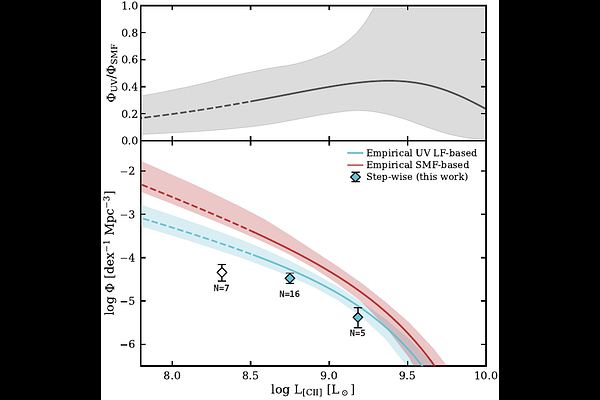
AbstractLuminosity functions (LF) are some of the most basic quantities providing insights into galaxy evolution across cosmic time and enabling a direct comparison between observations and simulations. Here, we present the first [CII]158$μ$m LF at $z\sim7$ from a sizeable UV-selected ALMA sample. Our analysis makes use of 27 galaxies with significant [CII] emission line detections in the epoch of reionization from the REBELS (Reionization Era Bright Emission Line Survey) ALMA Large Program and its pilot programs. We used these line detections and similar from ALPINE to calibrate UV luminosity-$L_{\mathrm{[CII]}}$ and stellar mass-$L_{\mathrm{[CII]}}$ relations at $z\sim7$. Given the challenge in precisely defining a selection volume for the REBELS sample itself, we rely on published UV LF and stellar mass function (SMF) determinations at $z\sim7$ and three complementary approaches to derive the [CII] LF. The UV LF-based method provides a lower limit on the [CII] LF, due to its missing the most dust-obscured systems. Our SMF-based estimate yields a Schechter function with a characteristic luminosity of $L^*_{\mathrm{[CII]}}=10^{9.11^{+0.11}_{-0.27}} L_\odot$ and a steep faint-end slope. From $z\sim7$ to $z\sim5$, our inferred [CII] LF shows an evolution of +0.3 dex in normalisation and +0.1 dex in $L^*_{\mathrm{[CII]}}$. Our results indicate a general underprediction from models of the abundance of [CII] emitters at high-redshift and thus potentially the number densities of massive yet UV-faint systems implied by our SMF-based method. Additionally, they suggest that 63% of the star formation rate density occurs in massive [CII]-bright systems and that $\sim$60-90% of [CII] emitters at $z\sim7$ may be missed by bright UV selections. This highlights the importance of surveys focusing on especially massive, UV-faint sources at $z>6$.