Compact CO emission and no evidence of radial drift. ALMA observations of the faintest planet-forming disks in Lupus

Compact CO emission and no evidence of radial drift. ALMA observations of the faintest planet-forming disks in Lupus
Giulia Ricciardi, Francesco Zagaria, Anna Miotello, Carlo F. Manara, Giovanni Rosotti, Luigi Zallio, Sean Andrews, Richard Booth, John Carpenter, Ilse Cleeves, Stefano Facchini, Viviana V. Guzmán, Claudia Toci, Miguel Vioque, David Wilner, Jonathan P. Williams
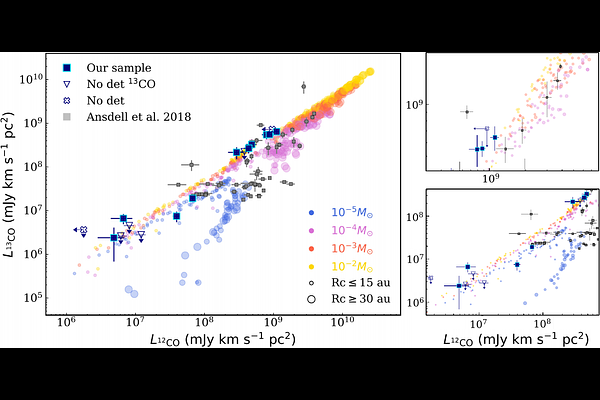
AbstractA large fraction of planet-forming disks observed with ALMA show faint CO emission, often interpreted as strong CO depletion. However, faint emission may also arise from spatially unresolved disks, whose sizes are overestimated, making them appear intrinsically faint. The limited sensitivity of previous observations has prevented testing this scenario, hindering our understanding of disk evolution and planet formation. We present new ALMA Band 7 observations of 12CO (J=3-2) and 13CO (J=3-2) in 17 of the faintest disks in Lupus, aiming to assess whether compact disk structure can explain their weak CO emission. The data reach an angular resolution of 0.25arcsec (about 20 au at 160 pc) and are an order of magnitude deeper than archival observations. We apply line stacking to enhance sensitivity and compare the derived CO luminosities with physical-chemical models of compact and extended disks, also estimating gas and dust sizes. We detect both isotopologues in 10 disks, only 12CO in 4, and neither in 3. Several disks are consistent with being intrinsically compact and optically thick in both lines, providing an alternative to the CO depletion scenario. The inferred gas radii (Rco less than 40 au) support this interpretation and suggest that a significant fraction of disks may be born compact, in line with recent Class 0/I results. Gas-to-dust size ratios show no clear evidence for dust evolution, indicating these disks are not drift-dominated.