A merger shock traced by radio arcs and ultra-long radio tails in galaxy cluster A2142

A merger shock traced by radio arcs and ultra-long radio tails in galaxy cluster A2142
Chong Ge, Ming Sun, Chris Nolting, Fabio Gastaldello, Dominique Eckert
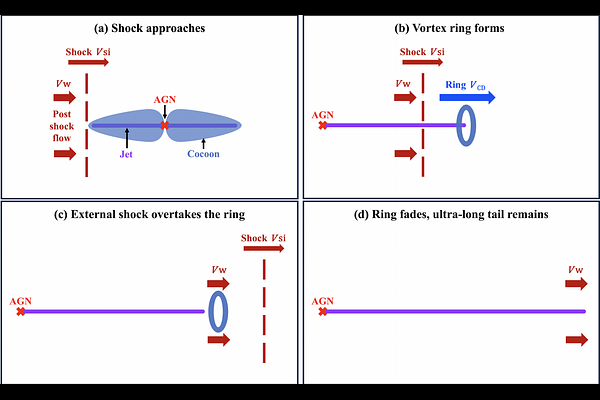
AbstractAbell 2142 (A2142) is a massive, nearby galaxy cluster undergoing a complex merger. It exhibits an elongated X-ray morphology along the northwest-southeast axis and hosts four known cold fronts. Using XMM-Newton observations, we detect a merger shock on the northwest side of the cluster with a Mach number of $M \sim 1.3$. The observed shock front and four cold fronts can be reproduced by numerical simulations of an off-axis merger with a large impact parameter, which imparts significant angular momentum to induce the sloshing of the subcluster core and large-scale ambient gas. In projection, the shock front is spatially coincident with arc-shaped radio filaments observed behind the prominent head-tail radio galaxies T1 and T2. We interpret these radio arcs as partial vortex ring structures (resembling ``smoke rings'') produced by the interaction of the merger shock with the low-density cocoons of radio galaxies. The shock strips and rolls the jet cocoon into a toroidal vortex, as predicted by recent magnetohydrodynamic simulations. We further demonstrate that the merger shock can significantly elongate the radio tails by re-accelerating aged relativistic electrons and stretching the tail plasma via the post-shock wind. This process provides a natural explanation for the $>$500 kpc tail observed in this and other merging clusters. Our findings establish radio arcs and ultra-long radio tails as independent, complementary tracers of merger shocks in galaxy clusters. Our results demonstrate that merger shocks can reshape both the thermal and non-thermal components of galaxy clusters, and that tailed radio galaxies serve as sensitive probes of intracluster medium weather.