A Virgo Environmental Survey Tracing Ionised Gas Emission (VESTIGE) XX. Star formation in the tidal tail of NGC 4254

A Virgo Environmental Survey Tracing Ionised Gas Emission (VESTIGE) XX. Star formation in the tidal tail of NGC 4254
A. Boselli, A. Lupi, P. Serra, P. Andreani, F. Calura, M-A. Miville-Deschenes, G. Hensler, M. Boquien, M. Fossati, S. Boissier, J. Braine, P. Cote, J. C. Cuillandre, F. de Gasperin, H. Edler, L. Ferrarese, G. Gavazzi, S. Gwyn, J. Hutchings, K. Kianfar, A. Longobardi, E. S. Mangola, S. Martocchia, E. Peng, H. Plana, J. Postma, J. Roediger, Y. Roehlly, M. Sun
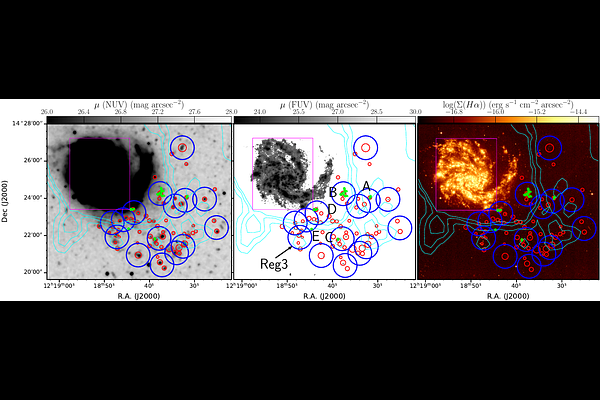
AbstractALMA 12CO(1-0) observations of 42 star-forming regions located outside the disc of the Virgo Cluster galaxy NGC4254 within an HI gas tail produced during the galaxy's interaction with another cluster member have revealed the presence of ten giant molecular clouds (GMCs) in four of these regions. All of the GMCs were resolved at the angular resolution of the observations (~160 pc) and have molecular gas masses of M(H2)~(0.8-2.0)x10^6} Mo. These ten clouds are characterised by gas column densities [S(H2)~10 Mo pc^-2] and velocity dispersions [sigma_v(CO)~3-12 km s^-1] respectively lower and comparable to those encountered in similar GMCs in the Milky Way. They follow the relation between the gas column density and the star formation activity (Schmidt law) derived using similar data over the stellar disc of NGC4254 and other local and Virgo cluster galaxies. With analytic calculations and tuned simulations, we show that these clouds are unstable and thus expected to dissolve on relatively short timescales (~10-30 Myr). We show that they probably formed after the collapse of dense gas clouds in the HI gas tail stripped during the gravitational interaction that the galaxy suffered several hundreds millions of years ago. The clouds are short-lived and isolated given the low density of the surrounding intracluster medium, which cannot confine the gas expelled by stellar feedback. We discuss the implications of these results in the general context of the fate of stripped gas in hostile cluster environments.