POLARIS: A Sparse Radial Neutrino Telescope Design for the Pacific Ocean

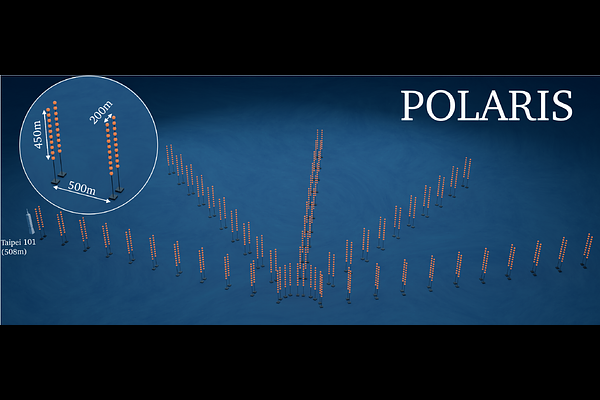
POLARIS: A Sparse Radial Neutrino Telescope Design for the Pacific Ocean
Karolin Hymon, Alexander Chen, Meng-Xue, Tsai, Wan-Ting Hseu, Tzu-Hsuan, Su, Anatoli Fedynitch
AbstractThe cubic-kilometer neutrino telescopes have opened neutrino astronomy as an observational discipline. The recent detection of KM3-230213A, the highest-energy neutrino ever observed at ~220 PeV, as a near-horizontal muon track underscores that the ultra-high-energy frontier is accessed through horizontal directions where the Earth's opacity above ~100 TeV confines the observable sky to a narrow band around and above the horizon. Yet extending general-purpose detector architectures into this regime requires disproportionate increases in instrumentation, cost, and logistical complexity. A compelling alternative is to deploy specialized detectors that target this natural geometry. POLARIS (Pacific Ocean Large Area Radial Instrumented Sparse array) is a sparse planar deep-water Cherenkov array optimized for neutrino-induced muon tracks from horizontal directions in the multi-TeV to PeV regime. By rotating the conventional vertical string layout into a radial planar configuration, the detector presents maximal cross-section to horizontal tracks while naturally suppressing the down-going atmospheric background. With only 1100 optical modules, the five-arm design reaches point source and diffuse flux sensitivities at PeV energies competitive with detectors deploying several times more instrumentation. As a dedicated $ν_μ$ track detector, POLARIS provides the muon-flavor channel that tau-optimized experiments such as TAMBO and Trinity do not cover, enabling full flavor composition measurements from astrophysical sources. Using the Prometheus simulation framework, this study demonstrates that targeted sparse geometries can open new discovery space at the high-energy frontier at a fraction of the cost of general-purpose arrays.