Kinematic structure and age of a Scorpius--Centaurus subcomponent: implications for PDS 70 planetary system

Kinematic structure and age of a Scorpius--Centaurus subcomponent: implications for PDS 70 planetary system
Arunima Arunima, Mike Ireland, Mark Krumholz
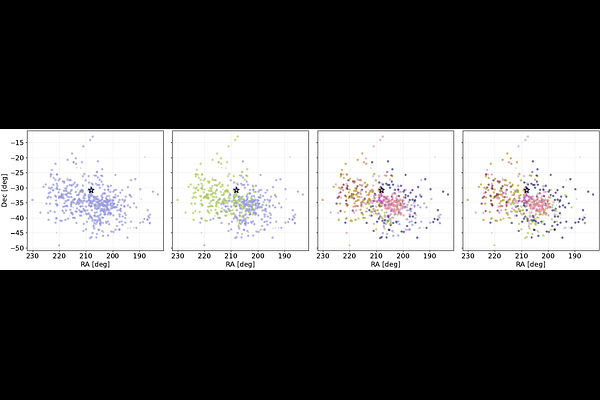
AbstractPDS~70, the only system with two directly imaged protoplanets embedded in their natal disk, is a benchmark for giant-planet formation theory. Interpreting the planetary luminosities requires a precise age for the host star, but the widely adopted isochronal age of $5.4\pm1.0$~Myr is substantially younger than ages inferred for the Upper Centaurus--Lupus (UCL) population with which it is associated. We address this discrepancy by determining a new kinematic age for PDS~70 using radial velocities for 405 candidate members of the Scorpius--Centaurus T subcomponent from the Wide Field Spectrograph (WiFeS) on the ANU 2.3~m telescope, reducing uncertainties by a factor of $\sim5.5$ compared to \textit{Gaia}. %We supplement these measurements with H$α$ and lithium equivalent widths as youth diagnostics. We combine these with \textit{Gaia} DR3 astrometry in the \texttt{Chronostar} kinematic reconstruction framework to derive a posterior-weighted kinematic age of approximately $10$--$15$~Myr for all the T subcomponent stars, with a kinematic age of $\approx 12$--$16$~Myr for PDS 70, ruling out ages as young as the published isochronal estimate. At this kinematic age, PDS~70~\textit{b}'s (and to a lesser extent, PDS~70~\textit{c}'s) luminosity is incompatible with warm-start cooling tracks under current dynamical mass constraints. The most natural interpretation is that PDS~70~\textit{b} formed $\approx10.5$ Myr after its host star, and no less than $\approx7.7$ Myr after it.