PDRS : A Linear $\mathcal{O}(N)$ Algorithm for Segmentation of High-Activity Regions in Irregularly Sampled Time Series

PDRS : A Linear $\mathcal{O}(N)$ Algorithm for Segmentation of High-Activity Regions in Irregularly Sampled Time Series
Atal Agrawal
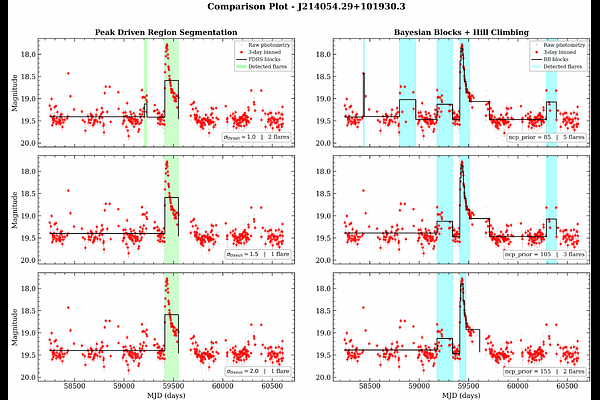
AbstractIdentifying transient high-activity episodes in astronomical time series requires partitioning data into regions of distinct statistical behavior. A widely adopted approach combines Bayesian Blocks with a hill-climbing procedure to isolate high-activity regions, but carries $\mathcal{O}(N^2)$ complexity -- a scalability challenge for wide-field surveys like ZTF and the upcoming Rubin Observatory (LSST), where light curves routinely contain thousands of irregularly sampled observations. We present Peak-Driven Region Segmentation (PDRS), a linear-time $\mathcal{O}(N)$ algorithm for rapid extraction of high-activity regions in irregularly sampled data. PDRS seeds candidate regions at statistically significant local maxima and expands them via a gradient-aware multi-source breadth-first search. Saddle-point merging and a median-based filter suppress spurious detections. Functioning as a computationally efficient pre-processing stage, PDRS isolates candidate transient events for downstream analysis. We demonstrate its efficacy on quasar light curves from SDSS Stripe~82 and AGN light curves from ZTF DR23, showing that PDRS identifies candidate high-activity regions comparable to those from Bayesian Blocks at substantially reduced cost. Its domain-agnostic formulation and physically interpretable parameters make PDRS broadly applicable beyond astronomy, including biomedical signals, seismic recordings, and industrial sensor monitoring.