QMCtwin: Master-Equation Simulation of Syndrome Statistics Beyond Pauli Noise

QMCtwin: Master-Equation Simulation of Syndrome Statistics Beyond Pauli Noise
Tong Shen, Huo Chen, Benchen Huang, Tyler Takeshita, Arian Vezvaee, Izhar Medalsy, Daniel A. Lidar
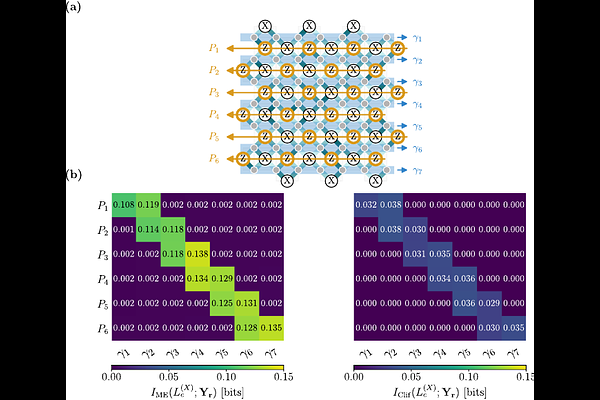
AbstractAs quantum error correction moves toward large-scale experimental implementations, decoder performance increasingly depends on how faithfully hardware noise is translated into syndrome statistics. Standard stabilizer workflows achieve scalability by replacing device dynamics with stochastic Pauli or detector-error models, but this compression can discard coherent phase information, nonunital drift, continuous-time effects of always-on couplings, and correlations generated by simultaneous Hamiltonian and dissipative evolution. Here we present QMCtwin, a sign-problem-suppressed quantum Monte Carlo framework for master-equation simulation of QEC circuits, and apply it to a full syndrome-extraction round of a distance-$7$ rotated surface code with $97$ physical qubits. The open-system model includes realistic superconducting-device noise mechanisms such as relaxation, pure dephasing, coherent gate miscalibration, residual $ZZ$ crosstalk, and drive-qubit detuning. By directly estimating syndrome observables from the QMC-generated stochastic density matrix estimator, we compare the master-equation dynamics with their Pauli-twirled Clifford simulation counterparts. QMCtwin predicts syndrome-extraction biases and correlations between syndromes and proxies of logical-string-parity that are absent or strongly suppressed in the stochastic Pauli description. We introduce information-theoretic diagnostics that further quantify how information concerning syndromes versus string-parity proxies differs between the realistic master-equation simulation and the corresponding Pauli-twirled model. These results show that QMC-based master-equation digital twins can expose noise features hidden by conventional Pauli/Clifford noise models and provide a practical path toward more accurate decoder-facing syndrome models.