A Comprehensive Study of Morphology and Kinematics in Extended Nebulae Around UV Luminous Quasars at $z\approx1$

A Comprehensive Study of Morphology and Kinematics in Extended Nebulae Around UV Luminous Quasars at $z\approx1$
Zhuoqi Liu, Sean D. Johnson, Eric F. Bell, Zhijie Qu, Benoît Epinat, Hsiao-Wen Chen, Marc Rafelski, Jennifer I-Hsiu Li, Alexander Beckett, Mandy C. Chen, Sayak Dutta, David DePalma, Gwen C. Rudie, Joop Schaye, Patrick Petitjean, Sebastiano Cantalupo, Elise Fuller, Wolfram Kollatschny, Sebastián López, Nishant Mishra, Sowgat Muzahid, Andrea Travascio, Fakhri S. Zahedy
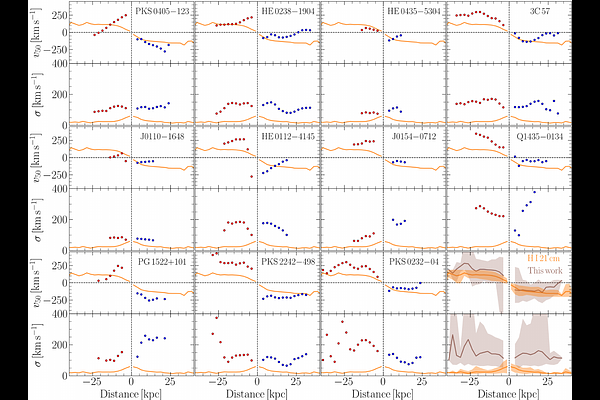
AbstractGas flows between galaxies and the circumgalactic medium (CGM) play a central role in galaxy evolution and can become observable as giant nebulae when illuminated by the quasars. We present an ensemble study of nebulae around 30 UV-luminous quasars at $z\approx0.4{-}1.4$ from the CUBS and MUSEQuBES surveys, 27 of which are detected in extended [O II] and/or [O III] emission. Based on a joint analysis of nebular morphology and surrounding galaxy environments, we introduce three morpho-kinematic classifications. We identify eleven irregular, large-scale (>50 kpc) systems, many of which are likely interaction-related; twelve compact host-galaxy-scale nebula, likely tracing CGM/ISM gas; and four systems with complex morphologies of uncertain origin. We introduce a quantitative measure of the spatial and kinematic association between nebulae and quasar-host group galaxies, finding a statistically significant association for ten nebulae, most of which are irregular, large-scale nebulae, consistent with qualitative analysis. Radio jets are detected in six systems, with no strong correlation found between radio activity and nebular emission. The [O II] nebulae are more asymmetric than their Lyalpha counterparts at $z>2$, but bear more similarity to H I gas observed in 21 cm around local elliptical galaxies. Blueshifted-redshifted patterns, likely tracing gas rotation, are observed in roughly 30% of the systems, though disturbed kinematics suggest that feedback may also be important. These results show that giant quasar nebulae are not a uniform class of objects, but instead arise through multiple pathways shaped by host-galaxy gas, galaxy interactions, group environments, and quasar activity, with the most striking cases associated with galaxy interactions.