Turning the knobs on dust evolution: Comparing codes, parameters and their effects on planet formation and disc observables

Turning the knobs on dust evolution: Comparing codes, parameters and their effects on planet formation and disc observables
Linn E. J. Eriksson, Thomas Pfeil, Nicolas Kaufmann, Vignesh Vaikundaraman
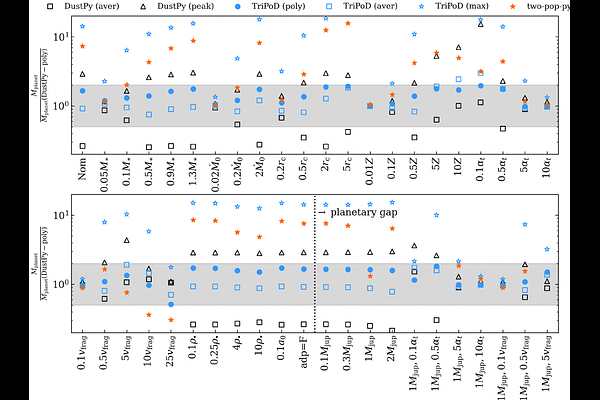
AbstractProtoplanetary discs contain a wide range of dust sizes that strongly influence their thermal structure and planet formation processes such as planetesimal formation and pebble accretion. Dust evolution models are therefore essential for both planet formation simulations and the interpretation of disc observations. Several open-source dust evolution codes are available, each adopting different methods and assumptions. We present a systematic comparison of 1D radial simulations using DustPy, TriPoD, and two-pop-py, and 2D radial-vertical simulations with TriPoD, mcdust, and cuDisc. The comparison includes dust size distributions, dust disc masses, planetary gap structures, millimetre fluxes and disc sizes from synthetic observations, planetesimal formation regions, and planetary growth via pebble accretion. We also perform a parameter study to assess how key dust-evolution parameters influence disc evolution, planet formation, and code agreement. In 1D, two-pop-py depletes dust masses faster and produces higher dust concentrations outside planetary gaps than DustPy or TriPoD. The latter two generally agree well, except when size distributions deviate strongly from a power law. While the calculated millimetre fluxes and disc radii typically agree well, planetesimal formation locations and pebble accretion rates vary significantly between codes. In 2D, we compare cuDisc, mcdust, and TriPoD in simulations of turbulence- and sedimentation-driven coagulation. The dust size distributions agree well, despite the completely different numerical approaches used to model dust coagulation. The largest differences arise in the upper atmosphere, where mcdust suffers from low mass resolution and TriPoD fails to reproduce the exact shape of size distributions that deviate from a power-law.