Present Day Cosmic Acceleration from SDSS and DESI BAO: A Call for Finer Tomography of the DESI Bright Galaxy Survey

Present Day Cosmic Acceleration from SDSS and DESI BAO: A Call for Finer Tomography of the DESI Bright Galaxy Survey
Anna Chiara Ferri, Ruchika, Alessandro Melchiorri
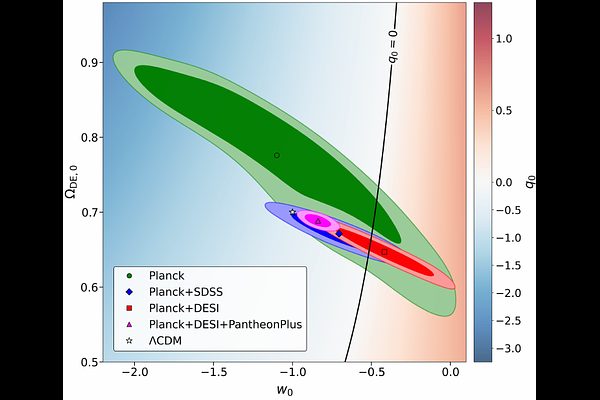
AbstractThe DESI collaboration's Data Release~2 (DR2) provides baryon acoustic oscillation (BAO) measurements from over 14 million galaxies and quasars, and a joint analysis of DESI BAO, CMB, and Type~Ia Supernovae reveals a preference for time-evolving dark energy. We quantify this preference relative to SDSS BAO and report three key results. First, DESI+Planck favors a higher $w_0 = -0.41^{+0.21}_{-0.22}$ than SDSS+Planck ($w_0 = -0.71^{+0.19}_{-0.18}$). Second, DESI+Planck prefers a deceleration parameter whose median lies on the decelerating side ($q_0 = 0.10^{+0.21}_{-0.23}$, consistent with $q_0 = 0$ at $1σ$), while SDSS+Planck prefers a negative value ($q_0 =-0.22^{+0.20}_{-0.21}$) indicating accelerated expansion. Third, we argue that this discrepancy arises from the difference in the lowest effective redshift probed by each survey: $z_{\rm eff} \approx 0.295$ for DESI versus $z_{\rm eff} \approx 0.15$ for SDSS. As present-day quantities, $w_0$ and $q_0$ are sensitive to the lowest probed redshift: data near $z = 0$ constrain them directly, whereas higher-redshift data rely on extrapolating the dark energy parametrization (here CPL). Reaching $z_{\rm eff} \approx 0.15$, SDSS constrains $w_0$ and $q_0$ in a data-driven way, finding consistency with $w_0 = -1$ and acceleration. Limited to $z_{\rm eff} \gtrsim 0.295$, DESI relies more on extrapolation, driving $q_0$ positive and $w_0$ well above $-1$. Adding the Pantheon+ supernova sample restores low-redshift information, returning $q_0$ to negative values and reducing tension with $Λ\text{CDM}$. We therefore propose that the apparent DESI preference for a non-accelerating present epoch in the BAO+CMB combination reflects redshift sampling rather than new physics, and suggest future DESI analyses adopt finer tomographic binning of the Bright Galaxy Survey sample to access lower mean redshifts and test this conclusion.