Identification of low redshift groups and clusters of galaxies in the X-CLASS survey and the X-ray luminosity-temperature relation

Identification of low redshift groups and clusters of galaxies in the X-CLASS survey and the X-ray luminosity-temperature relation
Q. Moysan, F. Sarron, N. Clerc, G. Soucail, C. Adami, B. Altieri, R. Cabanac, M. Chira, J. Comparat, D. Coia, E. Drigga, E. Gaynullina, A. Khalikova, E. Koulouridis, K. Migkas, M. Molham, L. Paquereau, T. Sadibekova, I. Valtchanov
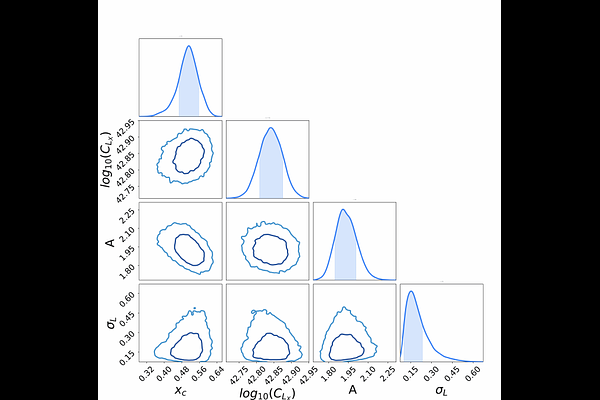
AbstractProperties of the hot intracluster and intragroup medium are mostly set by the underlying gravitational potential well, although complex astrophysical processes at play during their buildup may leave a significant imprint. Observational constraints on the degree and scales of such non-gravitational processes require well-selected samples of objects and deep observations of their gas content. We aim to study the scaling relation between two global properties of the hot gas, namely its soft-band X-ray luminosity ($L_X$) and its temperature ($T$), by studying a sample of low-mass systems associated with precise redshifts, simultaneously accounting for sample selection biases and associated measurement uncertainties. This work takes as input a large catalogue of X-ray-selected galaxy clusters (X-CLASS). We perform a thorough revision of the redshifts of sources using deep photometric data from the Legacy Surveys and our own tailored spectroscopic follow-up of 52 low-redshift systems. We devise a spectroscopically complete sample of 155 low-redshift ($0.07<z<0.2$) systems, and we measure properties of their X-ray emitting gas, with median $\overline{T}=1.7$ keV and median $\overline{L_X}=10^{43}$ erg s$^{-1}$. We infer the relation between $L_X$ and $T$ in a Bayesian framework. Our sample of groups and clusters with median total mass $\sim 6 \times 10^{13}M_\odot$ reveals a relation $L_X-T$ steeper than predicted by the self-similar model, with a slope $B=3.2 \pm 0.1$. This result fits well within recent studies that together indicate a trend of increasing slope with decreasing median halo mass. This work supports a scenario of a stronger decrease in luminosity with decreasing mass in the group regime than for massive galaxy clusters. This effect is possibly due to strong and sustained feedback expelling gas efficiently from their relatively shallower potential wells.