Divergent Evolution of Radial Metallicity Gradients in the Thin and Thick Disks of the Milky Way

Divergent Evolution of Radial Metallicity Gradients in the Thin and Thick Disks of the Milky Way
Weixiang Sun, Gaohuan Long, Hui Li, Han Shen, Shu Wang, Xiaodian Chen, Biwei Jiang, Xiaowei Liu, Di Li
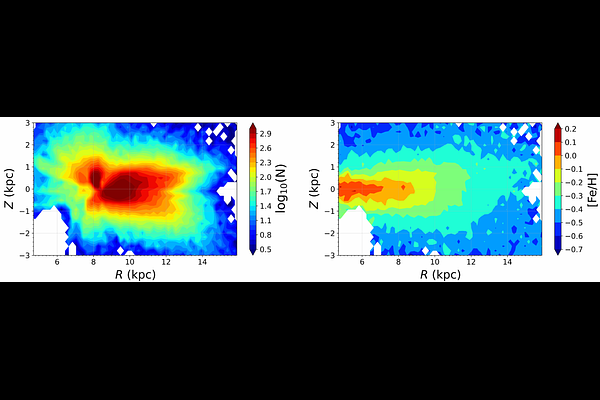
AbstractUsing 200,388 red clump stars from LAMOST and APOGEE, we investigate the radial metallicity gradients of the Galactic disk as a function of vertical height and stellar age. The thin disk displays a pronounced negative radial metallicity gradient near the Galactic mid-plane that progressively flattens with increasing $|Z|$, following $Δ\mathrm{[Fe/H]}/ΔR$ = $-$0.0784 $+$ 0.0776 (1 $-$ exp ($-$ $|Z|$/1.4244)). The thin disk also exhibits a clear age dependence in radial metallicity gradients, evolving smoothly from a strong gradient regime for young stars to a weak gradient regime for old stars, following $Δ\mathrm{[Fe/H]}/ΔR$ = $-$0.0438 $+$ 0.0233 tanh (($τ$ $-$ 11.2908)/4.2130). The thick disk shows weakly positive radial metallicity gradients that remain statistically invariant with respect to both vertical height and stellar age, following respectively, $Δ\mathrm{[Fe/H]}/ΔR$ = 0.0038 $+$ 0.0009 $|Z|$ and $Δ\mathrm{[Fe/H]}/ΔR$ = 0.0146 $-$ 0.0007 $τ$. These results indicate that the thin disk retains radial metallicity gradients shaped by relatively ordered inside-out growth and long-term secular evolution processes. The thick disk exhibits spatially and temporally homogeneous radial metallicity gradients, supporting a picture in which it formed rapidly during an early phase when the disk was dynamically hot and efficiently mixed, potentially in chaotic mergers of gas-rich systems and/or the turbulent ISM.