Characterizing the bolometric-photoevaporative transition in young sub-Neptunes with radiation-hydrodynamic simulations

Characterizing the bolometric-photoevaporative transition in young sub-Neptunes with radiation-hydrodynamic simulations
William Misener, Matthäus Schulik, Hilke E. Schlichting, James E. Owen
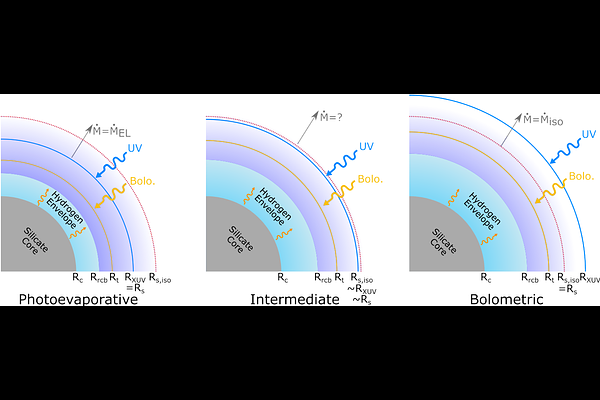
AbstractHydrodynamic atmospheric escape plays a central role in shaping the demographics of small, close-in exoplanets. Two mechanisms have been proposed to drive mass loss: photoevaporation, powered by UV irradiation, and core-powered mass loss, in which a bolometrically heated wind is sustained by cooling from the planetary interior. Although each mechanism can independently reproduce observed exoplanet demographics, both likely operate simultaneously. To quantify their combined impact, we use AIOLOS, a hydrodynamic radiative transfer code, coupled to a planetary evolution model to self-consistently compute atmospheric escape and planetary evolution. We find that as a typical sub-Neptune contracts, it evolves through distinct escape regimes. The youngest, most inflated planets drive a core-powered, bolometrically heated wind because UV radiation cannot reach the bolometric sonic point. This is followed by a transitional regime shaped by both bolometric and UV heating. As radii decrease further, escape rates approach the purely photoevaporative energy limit. We derive analytic scalings for the transition between these regimes, showing that it occurs at smaller radii for lower-mass and more highly irradiated planets, where core-powered escape dominates. Coupling both processes enhances escape even in more massive, cooler sub-Neptunes. We present the first combined mass-loss rates for a range of planet masses and XUV luminosities and show that the thermal structure below the UV absorption radius -- set by atmospheric composition -- also affects escape rates. These results integrate core-powered and photoevaporative escape into a unified framework, demonstrating that a self-consistent treatment of atmospheric composition, escape, and evolution is essential for understanding small exoplanets.