3D NLTE Sodium abundances in late-type stars. Abundance corrections and synthetic spectra

3D NLTE Sodium abundances in late-type stars. Abundance corrections and synthetic spectra
G. Canocchi, E. X. Wang, A. M. Amarsi, K. Lind, M. Racca
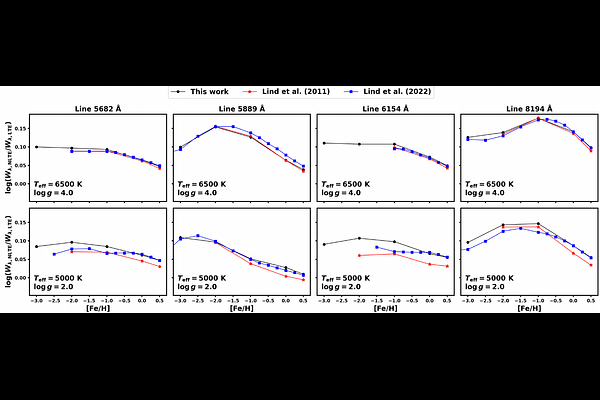
AbstractNeutral sodium is an important tracer of the Galactic chemical evolution, a powerful diagnostic of different stellar populations, and the subject of detailed studies of exoplanet atmospheres via transmission spectroscopy. This work aims to study and quantify the errors in stellar analyses of Na I lines caused by the use of one-dimensional (1D) hydrostatic model atmospheres and the assumption of local thermodynamic equilibrium (LTE). We studied the line formation of nine Na I lines in FGK dwarfs and giants via, for the first time, 3D non-LTE (NLTE) radiative transfer post-processing with the code Balder on 3D radiation hydrodynamic stellar atmospheres from the Stagger grid spanning Teff= 4000 to 6500 K, log g = 1.5 to 5.0, and [Fe/H]=-4 to +0.5. We find that the 3D NLTE abundance corrections relative to 1D LTE tend to be negative, and more positive than the corresponding 1D NLTE corrections. This reflects more efficient overionisation in the steeper temperature gradient of the 3D models. The corrections are typically less severe than -0.1 dex for weak lines, but become much larger for saturated lines in low-gravity giants (log g < 2.0), even reaching -0.7 dex. However, for the D resonance lines, the 3D NLTE corrections relative to 1D LTE become slightly positive at the lowest metallicities in our grid, typically around +0.05 dex at [Fe/H]=-4. We make our 3D NLTE grid, together with interpolation routines based on radial basis functions and fully connected feedforward neural networks, publicly available. This will enable more accurate determination of sodium abundances in present and forthcoming stellar spectroscopic surveys, particularly for metal-poor stars, as well as a better characterisation of the Na I D lines in exoplanet atmospheres.