From Fragments to Flares: Migration, Tidal Disruption, and Observable Bursts in Massive Protostellar Disks

From Fragments to Flares: Migration, Tidal Disruption, and Observable Bursts in Massive Protostellar Disks
Vardan Elbakyan, Rolf Kuiper, André Oliva, Verena Wolf, Jochen Eislöffel, Bringfried Stecklum, Christian Andreas
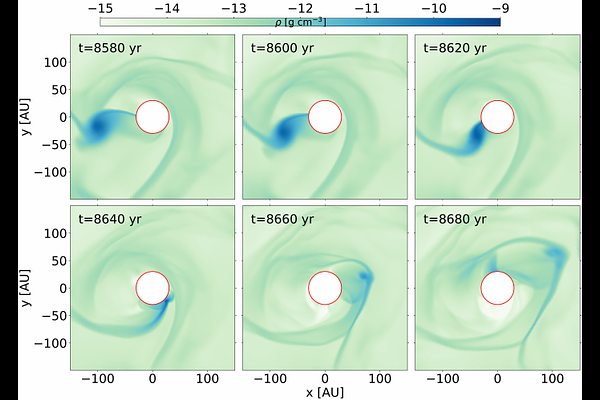
AbstractWe investigate how resolving the inner few astronomical units of a massive protostellar disk affects the migration, disruption, and accretion signatures of an inward-moving fragment. In particular, we aim to determine whether the predicted burst strength and duration depend on the adopted sink cell size. We present a new three-dimensional radiation-hydrodynamic simulation of a $\sim$5$M_{\odot}$ protostar surrounded by a self-gravitating disk, comparing the original 30 AU sink model to a refined model with a 1 AU sink that resolves the inner disk. The resulting gas structures are post-processed with radiative transfer calculations to derive synthetic photometry and multi-band images. Both simulations produce a major accretion burst as a migrating fragment is tidally disrupted, but their detailed behavior differs markedly. The refined model shows faster migration, a complete tidal disruption of the fragment, and a shorter, sharper outburst (more consistent with observations) with nearly the same peak accretion rate as the 30 AU model, which yields a broader, smoother event. The refined run produces much stronger near- and mid-infrared emission, reflecting the formation of a compact, hot inner disk. Resolving the inner few AU qualitatively changes the dynamics and observable appearance of fragment-driven bursts. Diffuse fragment disruption can reproduce decade-long events, but the much shorter ($<$3 yr) bursts observed in some massive protostars likely require the tidal disruption of more compact objects such as second Larson cores. Our trajectory analysis indicates that second Larson cores can migrate sufficiently close to the star to be tidally destroyed, offering a plausible mechanism for the fastest FU-Ori-like bursts observed in massive protostars.