Operating the Fabry-Pérot systems of the European Solar Telescope in multi-aperture mode

Operating the Fabry-Pérot systems of the European Solar Telescope in multi-aperture mode
G. B. Scharmer, M. G. Löfdahl, J. de la Cruz Rodríguez, B. Lindberg, H. Socas-Navarro, D. Kiselman, M. Rempel, J. Leenaarts
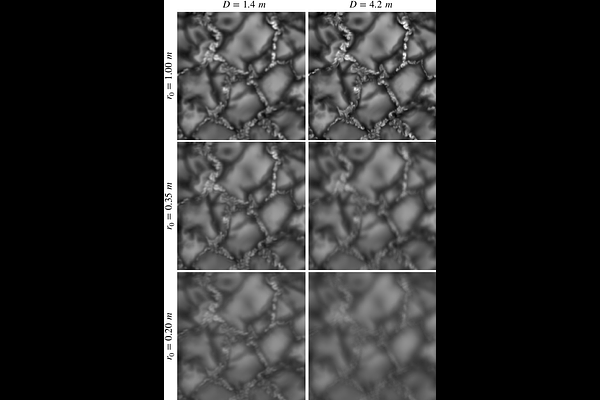
AbstractWe discuss how to optimise the science output of the European Solar Telescope (EST), when used without the wide-field compensation for high-altitude seeing that the EST multi conjugate adaptive optics (MCAO) will offer. This will be the mode of operating EST during its first year(s). Without MCAO, the spatial resolution of a much smaller telescope could surpass that of EST. We therefore propose to operate EST in multi-aperture mode, by optically segmenting the 4.2 m aperture into six 1.4 m subapertures, until MCAO is operational. Operating at smaller aperture diameter pushes down the root mean square wavefront errors from the high altitude seeing to levels that can more reliably be compensated for in restored images using post processing methods. This will significantly improve image quality. In particular, the multi-aperture mode will provide the sustained stable high image quality needed for obtaining time sequences of spectropolarimetric data. The multi-aperture mode is implemented with low-cost modifications of the camera lenses of the three Fabry-Perot systems that will be used to cover the wavelength range 380--860~nm. Switching between the full-aperture and multi-aperture modes can be done quickly and independently for the three FPI systems. This allows flexible optimisation of EST, taking into account that the seeing is much better at long wavelengths than at short wavelengths, without any impact on the EST primary or secondary optical systems or on the actual FPI systems. The multi-aperture addition to EST provides a powerful and flexible option that has the potential of significantly improving the quality and amount of its science data before MCAO is operational. In this publication, we perform simulations and image reconstructions of simulated data to demonstrate the benefits of the multi-aperture option, and provide a simple optical design to demonstrate its feasibility.