Enabling Chemically Accurate Quantum Phase Estimation in the Early Fault-Tolerant Regime

Enabling Chemically Accurate Quantum Phase Estimation in the Early Fault-Tolerant Regime
Shota Kanasugi, Riki Toshio, Kazunori Maruyama, Hirotaka Oshima
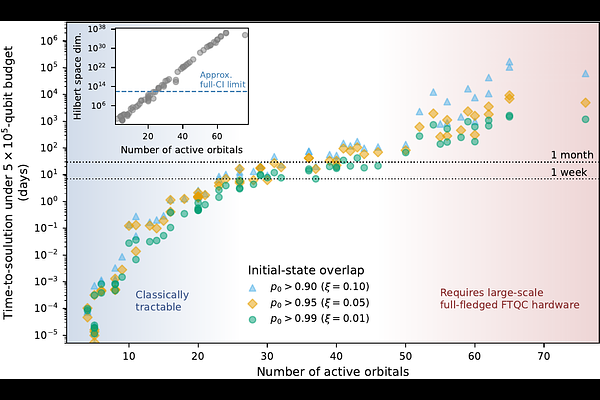
AbstractQuantum simulation of molecular electronic structure is one of the most promising applications of quantum computing. However, achieving chemically accurate predictions for strongly correlated systems requires quantum phase estimation (QPE) on fault-tolerant quantum computing (FTQC) devices. Existing resource estimates for typical FTQC architectures suggest that such calculations demand millions of physical qubits, thereby placing them beyond the reach of near-term devices. Here, we investigate the feasibility of performing QPE for chemically relevant molecular systems in an early-FTQC regime, characterized by partial fault tolerance, constrained qubit budgets, and limited circuit depth. Our framework is based on single-ancilla, Trotter-based QPE implementations combined with partially randomized time evolution. Within this framework, we develop a novel Hamiltonian optimization strategy, termed unitary weight concentration, that reduces algorithmic cost by reshaping linear-combination-of-unitaries representations. Applying this framework to active-space models of iron-sulfur clusters, cytochrome P450 active sites, and CO$_2$-utilization catalysts, we perform end-to-end resource estimation using the latest version of the space-time efficient analog rotation (STAR) architecture. Our results indicate that ground-state energy estimation for active spaces of approximately 20 to 50 spatial orbitals, well beyond the reach of classical full configuration interaction, is achievable using $\sim 10^5$ physical qubits, with runtimes on the order of days to weeks. These findings demonstrate that while full-fledged fault-tolerant quantum computers will be required for even larger molecular simulations, chemically meaningful quantum chemistry problems are already within reach in an experimentally relevant, early-FTQC regime.