Investigation of the Microquasar SS 433 with VERITAS

Investigation of the Microquasar SS 433 with VERITAS
The VERITAS Collaboration, A. Archer, P. Bangale, J. T. Bartkoske, W. Benbow, N. R. Bond, Y. Chen, J. L. Christiansen, A. J. Chromey, A. Duerr, M. Errando, M. E. Godoy, J. E. Pedrosa, S. Feldman, Q. Feng, S. Filbert, A. Furniss, W. Hanlon, O. Hervet, C. E. Hinrichs, J. Holder, T. B. Humensky, M. Iskakova, W. Jin, M. N. Johnson, E. Joshi, P. Kaaret, M. Kertzman, M. Kherlakian, T. K. Kleiner, N. Korzoun, F. Krennrich, S. Kumar, S. Kundu, M. J. Lang, M. Lundy, G. Maier, P. Moriarty, R. Mukherjee, M. Ohishi, R. A. Ong, A. Pandey, M. Pohl, E. Pueschel, P. L. Rabinowitz, K. Ragan, P. T. Reynolds, D. Ribeiro, E. Roache, I. Sadeh, L. Saha, H. Salzmann, M. Santander, G. H. Sembroski, S. Tandon, J. V. Tucci, D. A. Williams, S. L. Wong, J. Woo, T. Yoshikoshi
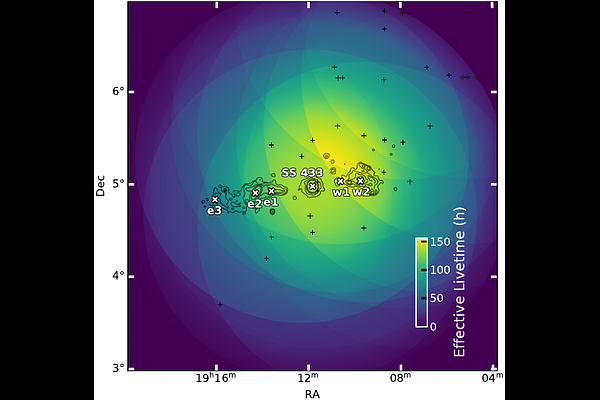
AbstractMicroquasars such as SS 433 are considered potential contributors to cosmic rays up to the knee of the cosmic ray energy spectrum ($\sim4\,\mathrm{PeV}$), where a transition in the dominant acceleration processes is expected. The SS 433 system, located within the W50 supernova remnant, is a Galactic microquasar with relativistic jets interacting with the surrounding medium over parsec scales, providing an example for studying jet-driven particle acceleration. A deep morphological and spectral study of SS 433 is performed using more than 150 hours of observations with VERITAS, sensitive to $γ$-ray energies $>100\,\mathrm{GeV}$. With an angular resolution better than $0.1^°$, extended TeV $γ$-ray emission is resolved from both the eastern and western jet lobes, located tens of parsecs from the central binary. The emission appears elongated along the jet axis and coincides with regions where the jets interact with the surrounding supernova remnant. No TeV emission is detected from the central binary, nor is significant emission observed between the central binary and the jet lobes. Phase-resolved analyses show no evidence for variability with orbital or precessional phase, supporting a steady emission scenario. The observed morphology and spectra are consistent with scenarios where particles are accelerated in the lobes of the jets, possibly through shocks or alternative processes such as magnetic reconnection. The extended TeV emission from the jet lobes of SS 433 favors a leptonic origin in the VERITAS energy range, suggesting any hadronic acceleration is subdominant. The results offer valuable constraints on how microquasar jets may contribute to the Galactic cosmic-ray population toward the knee.