The Effects of Energy Conservation in Simulating Solar Eruptions

The Effects of Energy Conservation in Simulating Solar Eruptions
Xianyu Liu, Spiro K. Antiochos, Nishtha Sachdeva, Gábor Tóth, Ward B. Manchester, Bart van der Holst, Igor V. Sokolov, Tamas I. Gombosi, Lulu Zhao
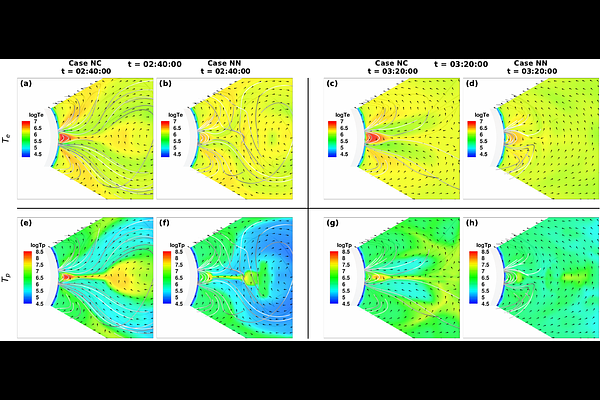
AbstractStrict energy conservation is, perhaps, the most basic principle in all physics, but has proven to be difficult to satisfy in numerical simulations of solar eruptions. The Alfvén Wave Solar atmosphere Model (AWSoM) is used to perform a rigorous comparison of CME simulations whose only difference is the use of a conservative vs. non-conservative scheme for the energy equation. A simple, symmetric active region is assumed for the initial magnetic field. As expected, the different numerical schemes result in very different plasma thermal energy, but surprisingly, we also find a factor $>2$ difference in the final kinetic energy, with the energy substantially larger in the energy-conservative scheme. The increase in thermal energy is comparable to the increase in kinetic energy in the conservative simulation. Our analysis reveals that the flare reconnection and increase of kinetic energy terminate earlier with the non-conservative scheme. We conclude that the plasma thermodynamics plays a critical role in the flare reconnection, with the thermal pressure gradient in the current sheet slowing down the reconnection. Our results imply that using strict energy-conservative numerics is critical for space weather modeling of CMEs and for understanding the CME energy budget partitioning.