High-energy neutrino emission from the Type~IIn supernova SN~2017hcd

High-energy neutrino emission from the Type~IIn supernova SN~2017hcd
Shunhao Ji, Zhongxiang Wang, Litao Zhu, Dong Zheng
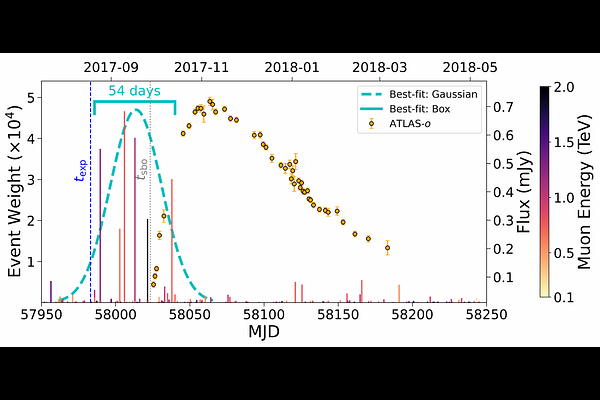
AbstractNeutrino astronomy provides another window to exploring the Universe, exemplified by the detection of a megaelectronvolt neutrino burst from the core-collapse supernova (CCSN) SN~1987A (refs.~\citenum{hir+87,bio+87}). Commonly discussed theories suggest that some CCSNe could produce neutrinos with energies a thousand times more than those of SN~1987A \cite{tm18}, which has been probed with new-generation facilities \cite{abb+12,aar+15,abb+23}. The interaction of SN ejecta with a dense circumstellar medium (CSM) or a jet, launched in a CCSN, being choked in the stellar envelope of the progenitor or an outside CSM are both well-accepted scenarios for the high-energy neutrino production. Here we report the detection of a high-energy neutrino flare at a 3.9$σ$ significance from SN~2017hcd, made by our analysis of the public track-like neutrino data taken by the IceCube Neutrino Observatory \cite{IceCube17}. A Type IIn SN with optical emissions arising from the ejecta--CSM interaction, SN~2017hcd's neutrino flare lasted $\sim$1--2 month, with its central time $\sim$14-day prior to the SN's optical discovery time. Its estimated isotropic neutrino energy (all flavors) is approximately two orders of magnitude higher than the energy ($\sim 10^{50}$\,erg) carried in the SN's ejecta, too high to be explained with the ejecta--CSM scenario. Thus, a choked jet may be the source of the neutrino flare.