Lie-algebraic incompleteness of symmetry-adapted VQE for non-Abelian molecular point groups

Lie-algebraic incompleteness of symmetry-adapted VQE for non-Abelian molecular point groups
Leon D. da Silva, Marcelo P. Santos
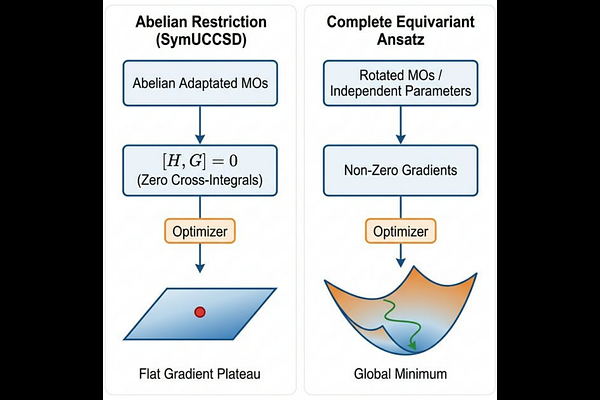
AbstractSymmetry-adapted variational quantum eigensolvers (VQE) based on the Unitary Coupled-Cluster ansatz (SymUCCSD) effectively reduce the parameter count for Abelian molecular point groups, yet they systematically fail for non-Abelian groups without a fully established theoretical explanation. In this work, we prove that the Abelian-subgroup restriction induces a spurious splitting of multidimensional irreducible representations, prematurely discarding cross-component excitations. At the Lie-algebraic level, this filter confines the Dynamical Lie Algebra (DLA) to the Abelian subalgebra $\mathfrak{u}(1)^{d_λ}$, restricting the reachable state manifold to a measure-zero torus $\mathbb{T}^{d_λ}$. However, completing the algebra is insufficient on its own due to a critical numerical trap: when standard molecular orbitals adapted solely to an Abelian subgroup are utilized, cross-component integrals vanish identically, creating an artificial zero-gradient plateau along non-Abelian algebraic directions. Numerical experiments on NH$_3$/STO-3G ($C_{3v}$, 16 qubits) confirm both the predicted DLA confinement and the gradient plateau, with SymUCCSD converging to an error of $21.8$~mHa above the FCI energy despite full optimizer convergence. Our analysis provides a rigorous algebraic and geometric diagnosis for the observed numerical breakdown, establishing that recovering full equivariant dynamics fundamentally necessitates both the inclusion of complete off-diagonal generators and the strategic parametrization of non-Abelian degrees of freedom.