Subsolar-mass binary mergers of strange stars and neutron stars: gravitational waves and ejecta

Subsolar-mass binary mergers of strange stars and neutron stars: gravitational waves and ejecta
Yong Gao, Ming-Zhe Han, Kenta Kiuchi, Masaru Shibata, Enping Zhou, Kenta Hotokezaka
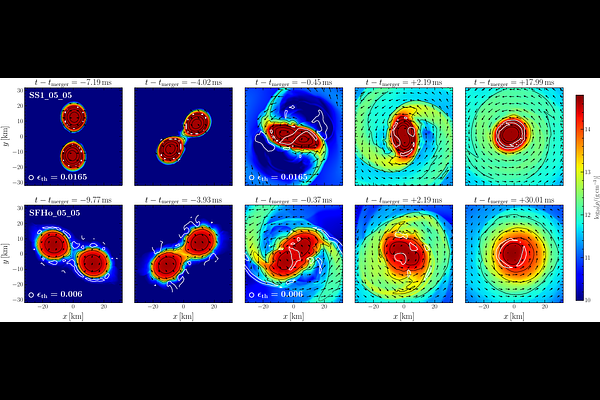
AbstractWe present the first numerical-relativity simulations of subsolar-mass binary strange star (SS) mergers and compare with binary neutron star (NS) mergers across equations of state, masses, and mass ratios. The self-bound nature of SSs makes them less deformed during the inspiral and keeps a sharp surface up to contact, driving strong shock heating and a large radial bounce that are far weaker in the NS. The more compact SS thus reaches a higher gravitational-wave cutoff frequency $f_\mathrm{cut}$ before contact but a lower post-merger peak frequency $f_2$. Within each class these frequencies follow quasi-universal relations with the tidal deformability, and their ratio $f_2/f_\mathrm{cut}$ cleanly separates the two classes. Both classes can eject $\sim10^{-2}\,M_\odot$ of material, neutron-rich for the NS and decompressed quark matter for the SS, a potential source of an electromagnetic counterpart whose observation could test the SS and NS hypotheses for subsolar-mass events.