Primordial Non-Gaussianity and the Field-Level Cramer-Rao Bound

Primordial Non-Gaussianity and the Field-Level Cramer-Rao Bound
Eugene Chen, Daniel Green, Vincent S. H. Lee
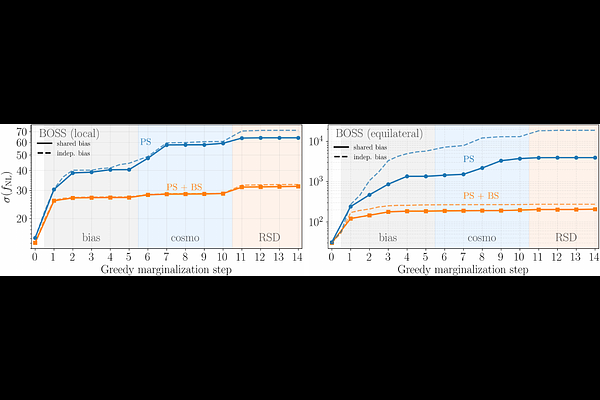
AbstractPrimordial non-Gaussianity is one of the most powerful probes of the inflationary epoch. The particle spectrum relevant to inflation, including masses and spins, is encoded in the precise form of statistical correlations of the adiabatic modes. Yet, in the presence of nonlinear structure formation, the optimal approach to measuring these signals remains unclear. Accurate modeling becomes crucial as late-time non-Gaussianty can become degenerate with primordial physics. Moreover, scale-dependent bias shows that information can move from non-Gaussian initial conditions to the amplitude of the Gaussian fluctuations. In this paper, we aim to clarify how primordial information is encoded in maps of galaxies. We use the field-level Cramer-Rao bound to investigate the ultimate limit of what can be extracted from realistic maps of the Universe. For local non-Gaussianity, we show that multi-tracer scale-dependent bias can exceed the sensitivity of conservative higher-point analyses. However, as expected, the multi-tracer analysis falls short of the optimal constraint when all the modes at the scale of the dark matter halos are included. We then forecast the potential reach of future surveys for equilateral and local non-Gaussianity. Equilateral in particular is highly sensitive to priors and modeling assumptions and can benefit dramatically from theoretical input such as the redshift evolution of the bias.