DDELenS: Tomographic Weak Lensing Simulations with Dynamical Dark Energy

DDELenS: Tomographic Weak Lensing Simulations with Dynamical Dark Energy
Shu-Fan Chen, J. Colin Hill, Zoltán Haiman
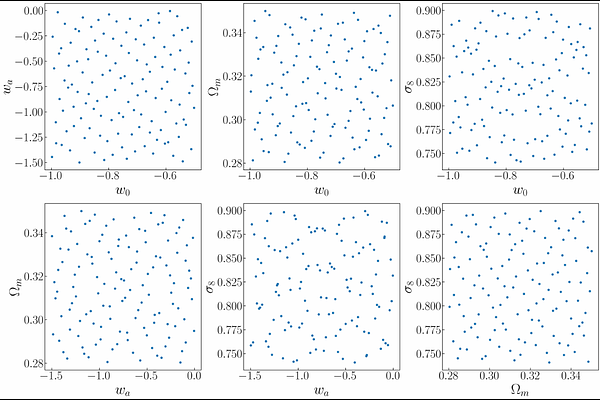
AbstractWe present a suite of 128 cosmological simulations in $w_0w_a$CDM cosmologies with massive neutrinos, designed to enable simulation-based inference of dynamical dark energy parameters from weak gravitational lensing and other cosmological observables. Each simulation follows $1024^3$ dark matter particles in a $512\,h^{-1}$Mpc periodic box, with cosmological parameters sampled using a Sobol sequence over the ranges $Ω_m \in [0.28, 0.35]$, $σ_8 \in [0.74, 0.90]$, $w_0 \in [-1.0, -0.5]$, and $w_a \in [-1.5, 0.0]$, motivated by recent results from the Dark Energy Spectroscopic Instrument survey. The nonlinear evolution is computed with $\texttt{PKDGRAV3}$ using the N-body gauge to consistently incorporate relativistic corrections from massive neutrinos, photons, and dark energy. For each cosmology, we generate 10,000 ray-traced convergence maps at six source redshifts $z_s \in \{0.5, 1.0, 1.5, 2.0, 2.5, 1100\}$ using $\texttt{LensTools}$, and additionally provide halo catalogues and projected halo overdensity fields for galaxy--lensing cross-correlation analyses. We generate 100,000 realizations at the fiducial cosmology for the construction of the covariance matrix. This simulation suite provides a foundation for field-level inference and non-Gaussian statistics with next-generation weak lensing surveys such as the Rubin Observatory LSST, Euclid, and the Nancy Grace Roman Space Telescope, as well as CMB lensing experiments including the Simons Observatory.