COCONUT: Toward practical time-evolving Sun-to-Earth magnetohydrodynamic modeling

COCONUT: Toward practical time-evolving Sun-to-Earth magnetohydrodynamic modeling
Haopeng Wang, Stefaan Poedts, Andrea Lani, Rayan Dhib, Luis Linan, Tinatin Baratashvili, Fan Zhang, Quentin Noraz, Hyun-Jin Jeong, Nicolas Wijsen, Martina Condoluci, Lingyu Dong, Junyan Liu, Rui Zhuo, Mahdi Najafi-Ziyazi, Ketevan Arabuli, Myrthe Flossie, Jasmina M. Magdalenić Zhukov, Brigitte Schmieder
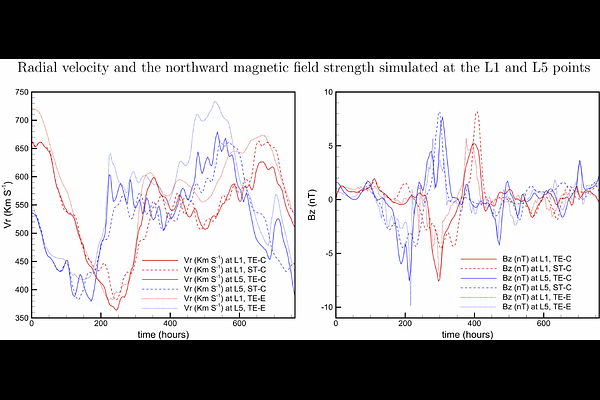
AbstractDue to computational efficiency and numerical stability limitations, coronal simulations constrained by static magnetograms are typically performed first and then used to drive inner-heliosphere (IH) models. In this paper, we calculate the Sun-to-Earth coronal and wind evolutions using a single time-evolving MHD model, showing that implicit MHD models have the potential to meaningfully simplify and improve the overall Sun-to-Earth modelling pipeline. We extend the implicit time-evolving coronal MHD model COCONUT out to 1 AU, and utilise it to investigate solar coronal and wind evolutions around a solar maximum Carrington rotation (CR). We compare quasi-steady-state and time-evolving Sun-to-Earth simulations to evaluate the impact of the inner-boundary magnetic field evolution, which is neglected in steady-state simulations, on background plasma parameters. Comparisons with commonly used coupled Sun-to-Earth simulations are also conducted to further validate and assess the Sun-to-Earth model COCONUT. The results show that the time-evolving implicit MHD modelling approach yields noticeable differences compared to oversimplified steady-state simulations, and is efficient enough for practical applications. Modelling the solar corona and wind using a single MHD model simplifies the modelling pipeline and avoids uncertainties associated with coupling different coronal and IH models. The noticeable differences in the temporal evolution of plasma parameters at the L1 and L5 points highlight the need to use continuously evolving, synchronised magnetic field observations to improve global coronal and solar wind simulations, whereas the overall consistent evolutionary trend reveals the reliability of using L5 observations to forecast solar wind conditions near Earth about four days in advance.