Observational Properties of Near-Maximally Spinning Supermassive Black Holes

Observational Properties of Near-Maximally Spinning Supermassive Black Holes
Tegan A. Thomas, Angelo Ricarte, Ben S. Prather, Hyerin Cho
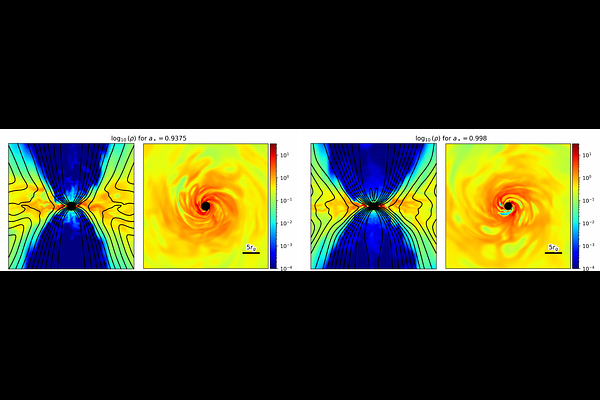
AbstractBlack holes described by the Kerr metric can have a theoretical maximum dimensionless spin parameter of $a_\bullet = 1$, but several effects may limit the maximum spin parameter in astrophysical systems. We perform general relativistic magnetohydrodynamics simulations of accretion flows around black holes with $a_\bullet = 0.9375$ and $a_\bullet = 0.998$, each corresponding to a proposed astrophysical limit in the literature. We then perform full polarized general relativistic ray-tracing to produce astrophysical movies of these simulations, as can be spatially resolved by the Event Horizon Telescope (EHT) and its extensions. Although many properties of black holes and accretion flows evolve rapidly as $a_\bullet \to 1$, we find that our $a_\bullet=0.9375$ and $a_\bullet=0.998$ simulations are remarkably similar, both in terms of their GRMHD fluid properties and their full-Stokes, time-variable images. This suggests that previous work using simulations with $a_\bullet \approx 0.9375$ may be representative of models with $a_\bullet \gtrsim 0.9375$ in most practical cases. Our calculations suggest that shape and size constraints on the photon ring, enabled by extensions of the EHT into space by missions such as the Black Hole Explorer (BHEX) may be the only practical way to distinguish between models with different spin parameters as $a\to 1$.