Beyond the [OIII]$λ$4363 auroral line: [NeIII]$λ$3868 as a direct tracer of electron temperature

Beyond the [OIII]$λ$4363 auroral line: [NeIII]$λ$3868 as a direct tracer of electron temperature
Borja Pérez-Díaz, José M. Vílchez, Marco Castellano, Ricardo Amorín, Davide Bevacqua, Adriano Fontana, Giovanni Gandolfi, Antonio Giménez-Alcázar, Laura Pentericci, Enrique Pérez-Montero, Paola Santini, Roberta Tripodi
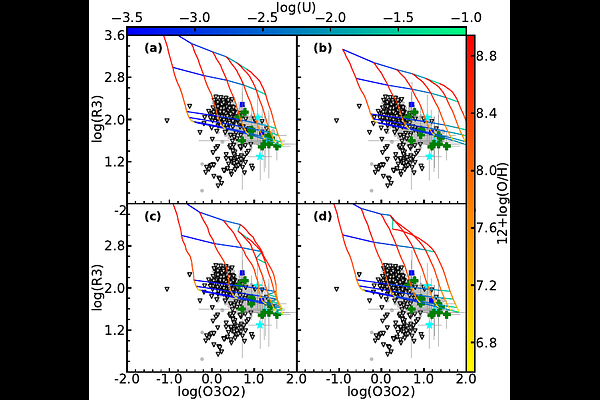
AbstractAuroral lines enable accurate measurements of chemical abundances in ionized gaseous nebulae thanks to their sensitivity to electron temperature. However, metal-enriched systems remain a challenge, as even deep observations cannot retrieve auroral lines due to their intrinsic faintness. To overcome this limitation, we present a novel approach to estimate electron temperatures in the conditions where the [OIII]$λ$4363 auroral line is barely detectable ($T_{e} < 11,000$ K). This approach relies on the detection of [NeIII]$λ$3868 and [OIII]$λ$4959,5007, which are among the brightest rest-frame optical emission lines. By means of detailed photoionization models, we derive a tight relation between the O3Ne3$\equiv$[OIII]$λ$4959,5007/[NeIII]$λ$3868 ratio and the electron temperature weighted in the O$^{++}$ dominated region. We test the validity of this relation in a large sample of galaxies that cover a wide range of redshifts z$\sim$0-9 and extragalactic HII regions. Our results show that the O3Ne3 ratio, in combination with the O3O2 ratio (tracer of ionization), yields electron temperature estimates consistent within the uncertainties with those based on [OIII]$λ$4363. The proposed relation can be used to estimate electron temperature in the cool (equivalently high-metal) regime [6,000, 13,500 K] where the emissivity of [OIII]$λ$4363 drops drastically.