JWST/MIRI Hydrocarbon and Water Absorption in the Wind of a Young Disk: Signatures of Pebble Drift and Carbon Grain Sublimation

JWST/MIRI Hydrocarbon and Water Absorption in the Wind of a Young Disk: Signatures of Pebble Drift and Carbon Grain Sublimation
María José Colmenares, Edwin A. Bergin, Ke Zhang, Geoffrey A. Blake, Klaus M. Pontoppidan, Alexa R. Anderson, John Carr, Emma Dahl, Joan Najita, Jonathan P. Williams, Colette Salyk, Till Kaeufer, Mayank Narang, Ilaria Pascucci, Benoît Tabone, Lucas Cieza, Miguel Vioque, Adrien Houge, Sebastiaan Krijt, Aditya M. Arabhavi, Giovanni Rosotti, John Carpenter, Feng Long, Paola Pinilla, Jayatee Kanwar, Eshan Raul, Karina Mauco, James Miley, Abygail Waggoner, the JDISCS collaboration
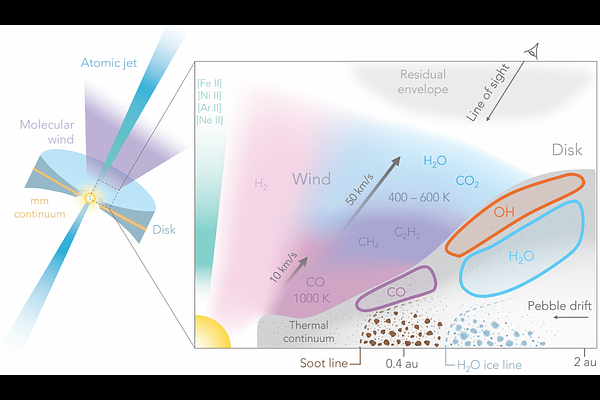
AbstractWe present JWST/MIRI-MRS observations of ISO-Oph 37, a highly inclined flat-spectrum ($\lesssim$1 Myr old) source, to investigate the chemical composition and dynamical origin of its inner-disk gas. The spectrum reveals a rich combination of molecular emission and absorption: H$_2$O, CO, and OH are detected in emission, while strong absorption is observed from CO, H$_2$O, CO$_2$, HCN, C$_2$H$_2$, and CH$_4$, with no detectable ice absorption features. LTE slab modeling of the absorption yields excitation temperatures of $T_{\rm ex}\sim400-600$ K and column densities of $\log N/{\rm cm}^{2}\sim16-19$, characteristic of warm gas located within the inner few au. The absorption lines are significantly blueshifted relative to the systemic velocity, with mid-IR lines exhibiting larger shifts than near-IR CO absorption. This velocity structure points to a velocity- and temperature-stratified molecular disk wind. In this framework, the absorption directly samples disk material lifted from the inner disk surface, preserving the chemical imprint of the wind-launching region. Along the line of sight, ISO-Oph 37 is unusually hydrocarbon-rich compared to other known absorption systems (GV Tau N and IRS 46), exhibiting high (C$_2$H$_2$+CH$_4$)/HCN, (C$_2$H$_2$+CH$_4$)/CO and H$_2$O/CO column density ratios, while the CO and HCN columns remain broadly typical. We find that these molecular ratios are best explained by enhancement of both hydrocarbons and water, driven by inward drift and sublimation of icy pebbles and by thermal processing of carbonaceous grains at the soot line. ISO-Oph 37 thus demonstrates that carbon-rich inner-disk chemistry can be established early in disk evolution and that it can be directly probed through molecular absorption in disk winds.