JOYS: Linking the molecular ice and gas-phase composition towards the high-mass hot core IRAS 18089-1732

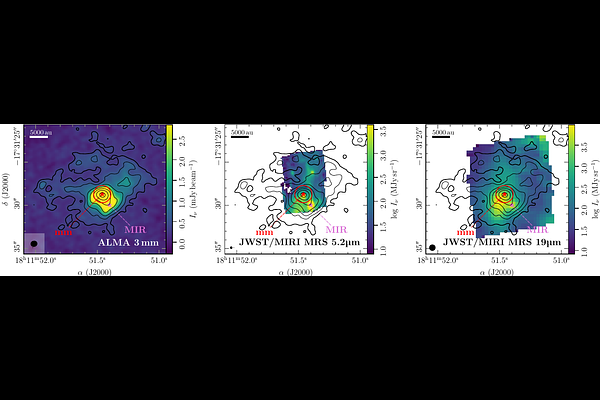
JOYS: Linking the molecular ice and gas-phase composition towards the high-mass hot core IRAS 18089-1732
C. Gieser, W. R. M. Rocha, Y. Chen, K. Slavicinska, E. F. van Dishoeck, P. Nazari, N. G. C. Brunken, L. Francis, H. Beuther, S. Reyes-Reyes, A. Caratti o Garatti, P. D. Klaassen, J. M. Vorster, M. G. Navarro
AbstractContext. The formation and destruction of molecules in the interstellar medium is a complex interplay between gas-phase reactions as well as processes on grain surfaces and within icy mantles. For many decades, the gas-phase composition of the cold material towards star-forming regions could be well characterized using (sub)mm facilities. Prior to the launch of the James Webb Space Telescope (JWST), ice species other than the main constituents (H2O, CO, CO2, NH3, CH4, CH3OH) were challenging to detect due to insufficient sensitivity as well as angular and/or spectral resolution. Aims. We determine molecular ice and gas-phase column densities towards the young and embedded high-mass hot core IRAS 18089-1732 within a region of 5000 au. Methods. We use spectroscopic data from 5-28 micron obtained with JWST to derive ice column densities of H2O, SO2, OCN-, CH4, HCOO-, HCOOH, CH3CHO, CH3COOH, C2H5OH, CH3OCH3, and CH3COCH3. Gas-phase column densities of a total of 38 molecules, including, O-, N-, S-, and Si-bearing species as well as less abundant isotopologues, are inferred from sensitive molecular line observations taken with the Atacama Large Millimeter/submillimeter Array (ALMA) at 3 mm wavelengths. Results. We find comparable abundances (relative to C2H5OH or CH3OH) in both phases for C2H5OH, CH3OH, and CH3OCH3. The abundances of SO2 and CH3COCH3 are higher in the gas-phase suggesting additional gas-phase formation routes. The abundance of CH3CHO is one order of magnitude higher in the ices compared to the gas-phase. The ice abundances (relative to H2O ice) towards the IRAS 18089 hot core are similar to previously studied Galactic low- and high-mass protostars. There are hints of a decreasing abundance with Galactocentric distance for OCN-, CH3OH, and CH3CHO ice. (abridged)