The power of entanglement in distributed quantum machine learning

The power of entanglement in distributed quantum machine learning
Yerim Kim, Kiwmann Hwang, Hyukjoon Kwon, Yosep Kim
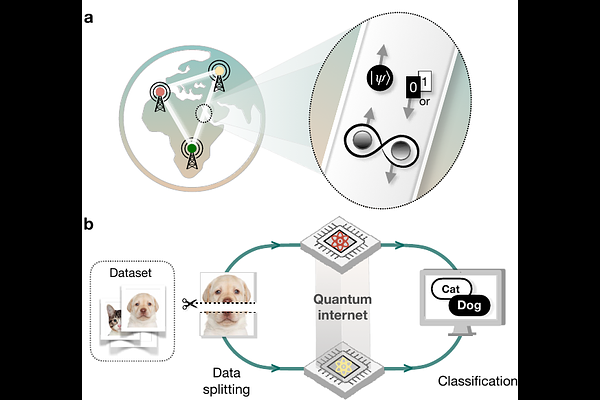
AbstractThe quantum internet aims to interconnect distant devices and enable large-scale computation through distributed quantum algorithms. One of the key obstacles is communication latency during computation. Even separations of a few hundred kilometers introduce millisecond-scale delays, which exceed the coherence times of many solid-state qubit platforms. In contrast, entanglement can be established beforehand and used as a practical resource to reduce communication complexity between remote nodes. Here we examine the utility of entanglement in distributed quantum machine learning for binary classification tasks. Drawing an analogy with the CHSH game, we show that entanglement improves classification accuracy across all datasets considered. We also find that excessive entanglement may degrade performance by reducing the effective dimension of the parameter space. This highlights the importance of using an appropriate amount and structure of entanglement in data embedding. Our findings bridge nonlocality and machine-learning advantage, providing a pathway toward distributed quantum computation beyond coherence-time constraints.