A large population of over-massive black hole quasars at z=0.3-0.8 revealed by eROSITA

A large population of over-massive black hole quasars at z=0.3-0.8 revealed by eROSITA
Johannes Buchner, Isabelle Gauger, Qiaoya Wu, Hattie Starck, Catarina Aydar, Yue Shen, Vardha N. Bennert, Kirpal Nandra, Sophia G. H. Waddell, Andrea Merloni, Mara Salvato, Roberto J. Assef, Zsofi Igo, Franz E. Bauer, Dong-Woo Kim, Anton M. Koekemoer, Donald P. Schneider
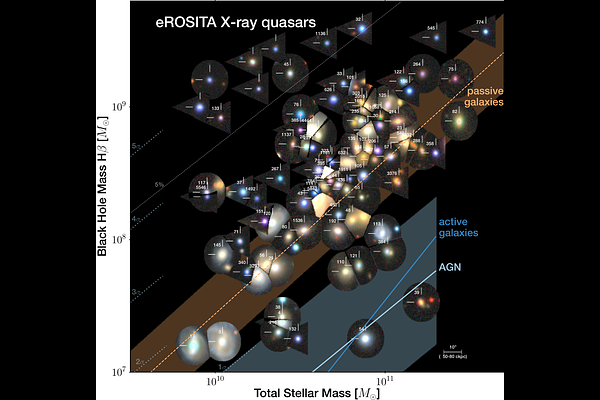
AbstractIn most galaxies, the central black hole accounts for no more than a percent of the total mass in stars. Recently, however, extremely over-massive black holes with ratios of 10% have been reported in dwarf galaxies at z<1 and at cosmic dawn (z>5.5) by JWST. Both findings have been interpreted as signatures of the still mysterious origins of super-massive black holes, such that most of the black hole mass was built at birth rather than through black hole accretion. Here we show that among evolved galaxies over-massive black holes are also present, indicating that overmassive BHs are not a signature unique to black hole formation channels. The first large-area sky survey of the eROSITA X-ray telescope on board SpectrRG identified 200 quasars by their luminous hard X-ray radiation. These signpost rapidly growing black holes. Complementary optical spectroscopy from the Sloan Digital Sky Survey and archival UV to IR photometric data combined with galaxy-quasar decomposition techniques allow us unbiased estimates of cosmological distances, black hole masses and host galaxy stellar masses. We securely identify a sample of over-massive black holes with BH-to-host ratios of more than 5%, which may have undergone exponential accretion spurts lasting about a billion years. Our survey identified a high space density of at least 4/Gpc^3 of overmassive black holes near cosmic noon. This indicates an accretion channel disconnected from the stellar population that cause strong deviations from galaxy scaling relations. This channel is currently not part of galaxy evolution models. The identified channel, if applicable also for the first billion years of cosmic time, can explain JWST AGN without requiring them to signify imprints of black hole seeding mechanism.