The Delay Time Distribution of Tidal Disruption Events

The Delay Time Distribution of Tidal Disruption Events
Margaret Shepherd, K. Decker French, Nicholas C. Stone, Nicholas Earl, Denyz Melchor, Teddy R. Smith, Jean Somalwar, Odelia Teboul, Margaret E. Verrico
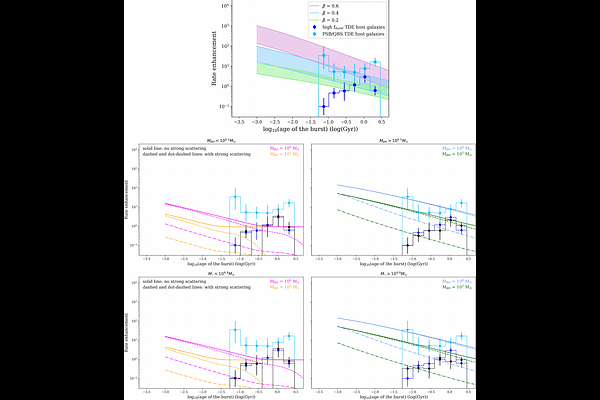
AbstractTidal disruption events (TDEs) can be observed when stars get too close to supermassive black holes and are torn apart and accreted. The delay time distribution of TDEs, or rate of TDEs as a function of time since a burst of star formation, can be used to determine what mechanisms influence the TDE rate. We compile a catalog of 41 TDE host galaxies with optical spectra, model the stellar populations with Bagpipes, and retrieve the age of the most recent burst of star formation to construct the delay time distribution of TDEs. TDEs occur more frequently in post-starburst galaxies than in other types of galaxies, though the mechanism causing this rate enhancement is unknown. We find that the TDE rate increases with post-burst age to reach a peak at ~1 Gyr relative to a control sample. We compare the observational TDE delay time distribution to theoretical models, which propose overdense stellar nuclei, radial anisotropies in stellar orbits, supermassive black hole binaries, and AGN disks as potential mechanisms that may enhance the TDE rate in post-starburst galaxies. Most models predict a TDE rate that declines with post-burst age, in contrast to our observational results, though some models are still feasible at certain ages (e.g., the black hole binary model matches at old burst ages and the stellar overdensity model matches at intermediate burst ages).