Baryons in the Darkest Sites of the Universe

Baryons in the Darkest Sites of the Universe
Kritti Sharma, Vikram Ravi, Dhayaa Anbajagane, William R. Coulton, Elisabeth Krause, Nico Schuster, Alice Pisani, Samuel McCarty, Liam Connor, Simone Ferraro, Nico Hamaus, Pranjal R. S
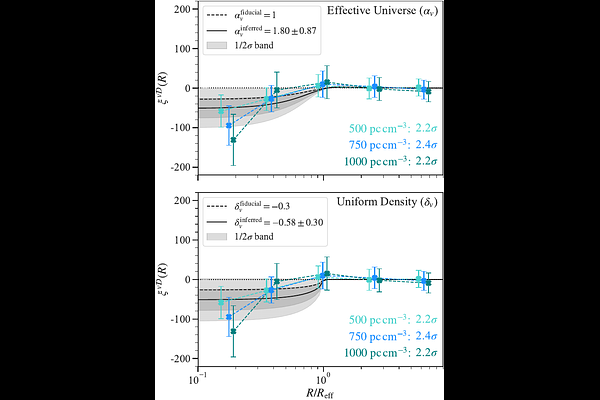
AbstractThe pristine underdense patches of the Universe, cosmic voids, are powerful cosmological laboratories, uniquely sensitive to dark energy, modified gravity, and neutrino masses, yet their baryonic content remains uncharacterized. We present the first observational constraint on baryon underdensity in void interiors, exploiting the dispersion measures (DMs) of Fast Radio Bursts (FRBs) as tracers of the free electron column, independent of gas phase, temperature, and metallicity. By stacking 3,455 sightlines from CHIME/FRB on 1,288 SDSS BOSS voids over redshifts $0.2 < z < 0.7$, we measure a DM deficit toward void centers at $3.2σ$ significance, establishing that diffuse baryons inhabit the emptiest corners of the cosmic web at a suppressed level. The measured signal amplitude is consistent with an effective Universe model built directly from the observed galaxy underdensity in these voids, and a baryonic model calibrated to the FRB DM-redshift relation ($α_v = 1.80 \pm 0.87$). A uniform-density void model yields an electron density contrast of $δ_\mathrm{e,v} = -0.58 \pm 0.30$, implying a $\sim 60$% underdensity of baryons in void interiors relative to the cosmic mean. Jointly interpreting our FRB measurement with existing stacks of the thermal Sunyaev-Zel'dovich effect on voids further constrains the mean void gas temperature to $T_\mathrm{e} \lesssim (1.1 \pm 0.7) \times 10^6$ K, pointing to a warm-hot diffuse phase, consistent with hydrodynamical simulation predictions. With forthcoming FRB (CHORD, DSA, SKA) and galaxy (DESI, LSST, Euclid, PFS-Subaru, SPHEREx, Roman) surveys, set to expand both samples by orders of magnitude, this approach opens a new window onto tomographic baryon mapping, with direct implications for feedback models governing gas expulsion into low-density environments, and for the use of cosmic voids to extract cosmological constraints.