The Cost of Circularity: Quantifying Eccentricity-Induced Biases in Binary Black Hole Inference

The Cost of Circularity: Quantifying Eccentricity-Induced Biases in Binary Black Hole Inference
Tamal RoyChowdhury, V. Gayathri, Rossella Gamba, Shubhagata Bhaumik, Imre Bartos, Jolien Creighton
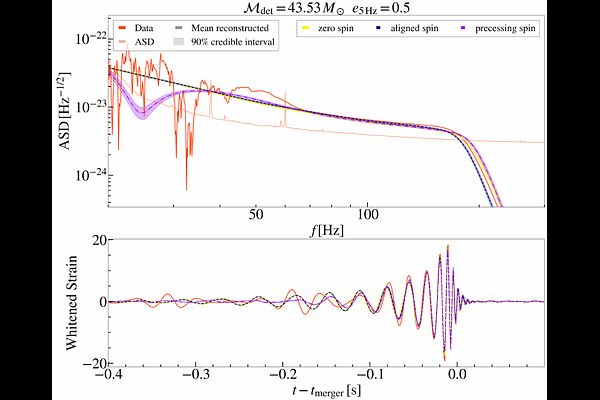
AbstractDynamically assembled binary black holes are expected to retain measurable orbital eccentricity in the LIGO-Virgo-KAGRA band, but most parameter estimation analyses still assume quasi-circular inspirals. This raises a critical question: how strongly does unmodeled eccentricity bias the inferred properties of BBH mergers? We address this by injecting eccentric signals generated with TEOBResumS-Dali and recovering them using the circular, precessing IMRPhenomXPHM waveform model. Across $20$-$80 \, M_\odot$ and eccentricities up to $e=0.5$, we find that circular waveform models remain reliable only for very small eccentricities. Above $e\sim0.2$ at 10 Hz, recovered masses, spins, inclination, and distances begin to show significant systematic offsets. Circular precessing templates mimic eccentric amplitude and phase modulations by introducing artificial precession, highlighting a major degeneracy between these effects. For high-mass, moderately eccentric mergers, circular models misestimate parameters at a level that would bias astrophysical interpretation and population studies. Our results establish the parameter-space boundaries where eccentric waveform models become essential for accurate inference in current and next-generation detectors.