Environmental Quenching of High-Redshift Galaxies: Interpreting JWST Observations with Simulations

Environmental Quenching of High-Redshift Galaxies: Interpreting JWST Observations with Simulations
Aleyna Döven, Mohammadreza Ayromlou, Cristiano Porciani
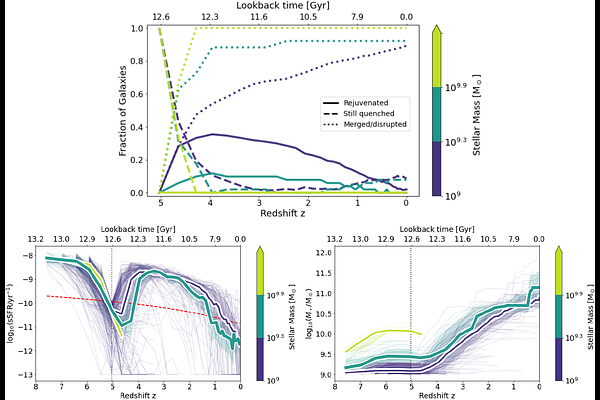
AbstractRecent observations of the high-redshift Universe, particularly with JWST, have revealed a population of quenched galaxies that challenges current galaxy formation models, which systematically underpredict their abundance. This discrepancy has been extensively studied for massive systems, motivating revisions to internal quenching mechanisms such as AGN feedback. However, the origin of quenching in lower-mass galaxies at high-z has received far less attention, largely due to previous observational limitations. JWST has now identified low-mass quenched galaxies (${M_{\star}}<10^{10}{\rm M_{\odot}}$). Given this emerging observational evidence, we investigate the viability of environmental quenching as the primary mechanism suppressing star formation in low-mass galaxies at $z>3$. We analyze several simulations, including L-GALAXIES, IllustrisTNG, SIMBA, and TNG-Cluster, jointly comprising more than half a million galaxies at z=5. Across all simulations, quenched systems are overwhelmingly satellites, despite representing less than 10\% of the total galaxy population. Satellite quenching increases with host halo mass and decreases with both stellar mass and halocentric distance, showing strong correlations with enhanced ram-pressure exposure and gas depletion. The simulations, particularly L-GALAXIES, produce low-mass quenched galaxies broadly consistent with those observed by JWST. Our results suggest that the recently discovered high-redshift quenched low-mass galaxies are possibly environmentally quenched systems residing in the vicinity of massive halos. According to the simulations, these galaxies are often only temporarily quenched: nearly 90\% of them merge within a few hundred megayears, and a small fraction rejuvenate and resume star formation. Extended samples from future observations will enable robust tests of the environmental origin of galaxy quenching in the early Universe.