PySME v1.0: improved modelling of stellar spectra for survey-scale applications

PySME v1.0: improved modelling of stellar spectra for survey-scale applications
Mingjie Jian, Nikolai Piskunov, Jeff Valenti, Ella Xi Wang, Brian Thorsbro, Henrik Jönsson, Ansgar Wehrhahn
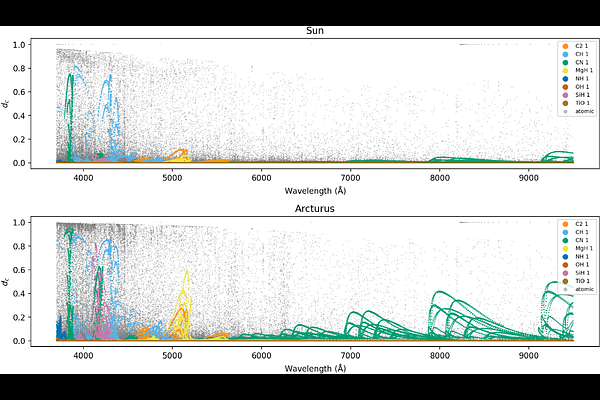
AbstractStellar abundance analysis relies on flexible, high-performance spectral synthesis. To meet these needs, we present PySME v1.0, an updated Python implementation of Spectroscopy Made Easy (SME) designed for precise and survey-scale modelling of stellar spectra.A central challenge in SME based synthesis is the efficient treatment of very large line lists, including both the preselection of negligible lines and the subsequent formal synthesis. PySME v1.0 introduces a revised line-selection framework based on opacity ratio and line depth, together with dynamic line list construction and control of the effective wavelength span over which each line contributes to the synthetic spectrum. These workflows support parallel preprocessing of weak-line selection and reduce the line list passed to the synthesis core, thereby improving scalability while preserving synthetic accuracy. PySME v1.0 also incorporates an updated equation-of-state treatment that improves the modelling of hydrogen lines, particularly Balmer features, while maintaining close agreement with previous SME results for metal lines. The Python interface has further been extended to support parameter-dependent derived quantities updated during optimisation, and PySME provides non-local thermodynamic equilibrium (NLTE) departure-coefficient grids for 17 elements. Together, these developments establish PySME v1.0 as a robust and efficient framework for high-precision stellar abundance analyses in large spectroscopic surveys.